
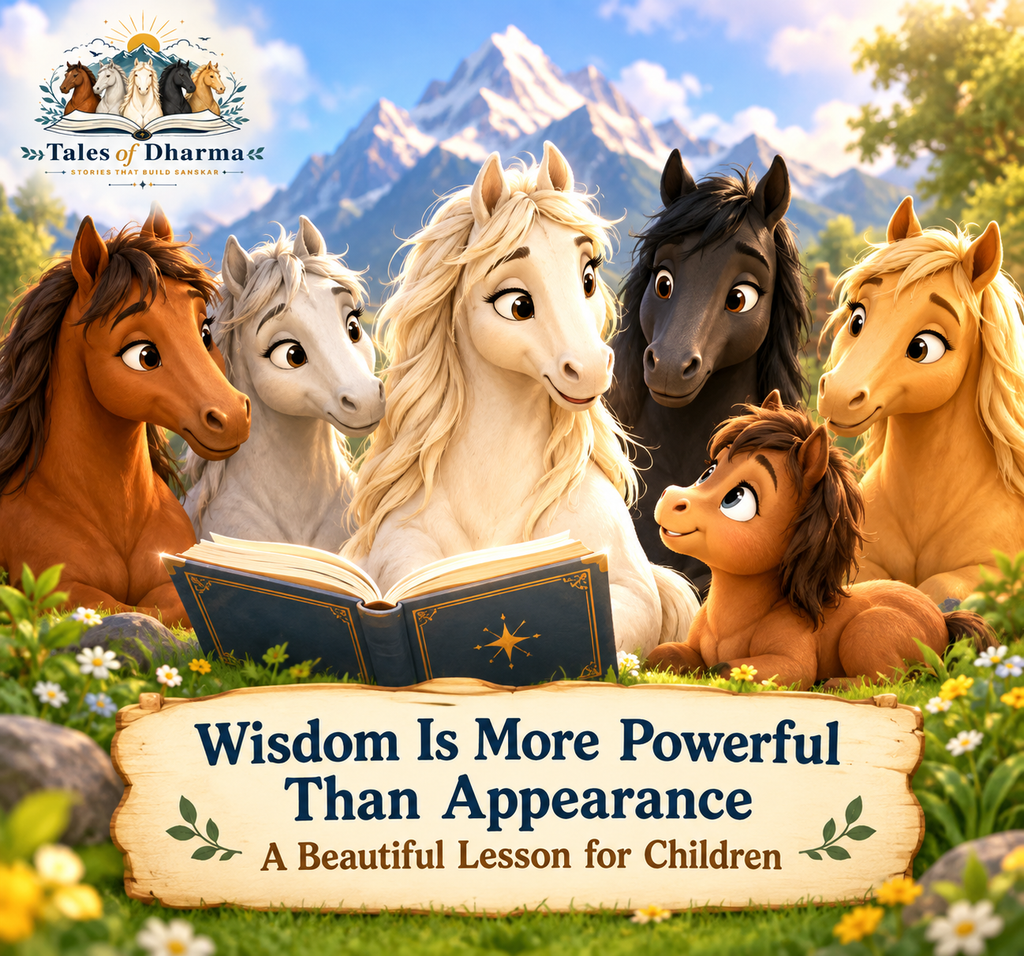
Have you ever looked at someone and immediately decided what they were like?
Perhaps they looked quiet, so you thought they were shy.
Perhaps they were small, so you thought they were weak.
Perhaps someone looked different from you, so you assumed they could not understand you.
But what if appearances could not tell you the whole story?
A person may have a beautiful face but an unkind heart. Someone may look ordinary but possess incredible knowledge. A quiet child may have the wisest idea in the room.
This is why one of the most valuable lessons we can teach children is:
Wisdom is more powerful than appearance.
Appearance tells us what something looks like.
Wisdom helps us understand what something truly means.
And this lesson appears again and again in Indian stories, Hindu mythology, Panchatantra tales, and traditional wisdom.
What Does “Wisdom Is More Powerful Than Appearance” Mean?
Wisdom is not simply knowing many facts.
A wise person knows how to use knowledge in the right situation.
Wisdom can mean:
- Thinking before speaking
- Understanding consequences
- Making thoughtful decisions
- Knowing when to be brave
- Knowing when to be kind
- Learning from mistakes
- Listening to others
- Looking beyond appearances
Appearance, on the other hand, is what we notice from the outside.
It can include someone’s clothes, height, age, beauty, wealth, strength, or physical appearance.
These things may tell us something about how a person looks, but they do not tell us everything about their character.
A simple person can have extraordinary wisdom.
A powerful-looking person can make poor decisions.
That is why children should learn to look beyond what they see.
A Beautiful Example From Lord Ganesha
One of the most memorable examples of wisdom in Hindu mythology is Lord Ganesha.
Ganesha is often recognised by his elephant head, large ears, round belly, and single tusk.
A child seeing Ganesha for the first time might naturally ask:
“Why does he look different?”
That question creates an opportunity to teach something deeper.
Ganesha’s appearance is not presented simply as something unusual. His form is traditionally understood through symbolism and stories connected with wisdom, understanding, strength, and overcoming obstacles.
His large ears can inspire a conversation about listening.
His elephant head can become a starting point for discussing intelligence and thoughtful thinking.
His single tusk is connected with traditional stories about determination and sacrifice.
The deeper lesson is simple:
Do not judge someone by appearance. Look at their qualities, actions, and wisdom.
The Story of Ganesha and His Parents
There is a popular story in Hindu tradition that beautifully demonstrates the importance of wisdom.
One day, a challenge was given to Ganesha and his brother Kartikeya.
They were asked to travel around the world.
Kartikeya immediately set off on his magnificent vehicle, the peacock.
Ganesha’s vehicle was much smaller: a little mouse.
How could he possibly travel around the world on such a tiny vehicle?
Instead of competing through speed, Ganesha thought carefully.
He walked around his parents, Shiva and Parvati, and said that for him, his parents represented his entire world.
The story is traditionally told as an example of Ganesha using wisdom rather than physical speed.
Kartikeya had the ability to travel quickly.
Ganesha used a different kind of strength: thoughtfulness and understanding.
For children, this creates a wonderful question:
“Do you always have to be the fastest or strongest to solve a problem?”
The answer is no.
Sometimes, the person who stops, thinks, and understands the situation can find the solution that others miss.
Wisdom Can Be Quiet
Children sometimes think that being smart means knowing every answer.
But wisdom can look very different.
A wise child might say:
“I don’t know. Let me think.”
A wise child might listen while everyone else is talking.
A wise child might admit:
“I made a mistake.”
A wise child might choose kindness instead of winning an argument.
These are not signs of weakness.
They can be signs of maturity.
One of the most important lessons parents can teach is that being wise is not about trying to look clever. It is about making thoughtful choices.
Why Children Should Not Judge Others by Appearance
Children naturally notice differences.
They may notice someone’s clothes, hairstyle, skin colour, language, height, abilities, or physical features.
Curiosity is normal.
What matters is teaching children not to turn differences into judgments.
You can teach them to ask:
“What kind of person are they?”
“Are they kind?”
“Do they help others?”
“Do they listen?”
“Are they honest?”
“What can I learn from them?”
These questions move the focus from appearance to character.
A child who learns this early can grow into an adult who is more thoughtful and respectful toward others.
The Wisdom of the Panchatantra
Indian children’s literature has long used animals and clever characters to teach practical wisdom.
The Panchatantra is famous for stories in which characters solve problems through intelligence, patience, strategy, and understanding rather than physical strength alone.
A small animal may outsmart a much larger one.
A seemingly ordinary character may notice something that everyone else misses.
These stories are especially useful for children because they turn an abstract lesson into an exciting adventure.
A child may forget a lecture about “critical thinking.”
But they are much more likely to remember a clever story in which a small character solves a huge problem.
That is the power of storytelling.
Appearance Can Change, Character Matters More
Think about a beautiful flower.
It may look wonderful when it first blooms.
But its appearance does not tell you everything about its fragrance, strength, or ability to grow.
Similarly, people cannot be fully understood from their appearance.
A person’s character is revealed through their actions.
How do they treat someone who cannot help them?
How do they behave when nobody is watching?
What do they do after making a mistake?
How do they respond when someone else succeeds?
These moments reveal much more than appearance ever can.
Wisdom Means Knowing When to Look Deeper
Imagine two children see an old man sitting quietly in a park.
One child thinks:
“He looks ordinary.”
Another child sits beside him and starts a conversation.
The child discovers that the man has travelled to many countries, knows fascinating stories, and has learned lessons from a lifetime of experiences.
The first child saw an appearance.
The second discovered a person.
That is what wisdom encourages us to do.
Look deeper.
How Parents Can Teach This Lesson to Children
You don’t need a complicated lesson plan.
Small everyday conversations can make a big difference.
Ask children questions
When your child makes a judgment about someone, gently ask:
“What makes you think that?”
“Could there be another explanation?”
“How would you feel if someone judged you without knowing you?”
These questions encourage children to think rather than simply react.
Use stories
Stories from Hindu mythology, Panchatantra, Indian folklore, and family traditions can introduce children to characters whose wisdom is more important than their appearance.
Praise thoughtful decisions
Instead of praising only achievements, notice good thinking.
Say:
“I like how you thought about that.”
“You listened before answering.”
“You found a peaceful solution.”
“You admitted your mistake. That was brave.”
This teaches children that wisdom is something they can practise.
Teach children to listen
Listening is one of the simplest forms of wisdom.
Encourage children to listen to grandparents, teachers, friends, and people with different experiences.
They may discover that everyone has something to teach.
Wisdom Is More Than Intelligence
There is an important difference between intelligence and wisdom.
A child may be excellent at mathematics but still struggle to understand how their words affect others.
Another child may not always get the highest marks but may know how to comfort a friend who is upset.
Both abilities matter.
Intelligence helps us understand information.
Wisdom helps us decide what to do with that understanding.
That is why character education is so important for children.
We want children not only to know more but also to think better, care more, and make thoughtful choices.
A Simple Lesson Children Can Remember
If you want to explain this idea to a young child, try this:
“Your eyes can see how someone looks, but your heart and mind help you understand who they are.”
Then ask:
“Would you want someone to decide what kind of person you are just by looking at you?”
Most children will immediately understand the answer.
This simple conversation can become a powerful lesson about kindness, empathy, and respect.
Frequently Asked Questions
Why is wisdom more powerful than appearance?
Appearance tells us what something looks like, while wisdom helps us understand situations, make thoughtful decisions, and recognise what truly matters.
How can I teach wisdom to my child?
Encourage children to ask questions, think before reacting, listen to others, learn from mistakes, solve problems independently, and discuss the lessons in stories.
What are good moral stories for teaching wisdom to kids?
Panchatantra stories, Jataka tales, and age-appropriate stories from Hindu mythology can provide engaging examples of intelligence, patience, courage, kindness, and wise decision-making.
What can children learn from Lord Ganesha?
Stories about Lord Ganesha can introduce children to ideas such as wisdom, listening, determination, humility, knowledge, and overcoming obstacles.
Is being intelligent the same as being wise?
Not necessarily. Intelligence can involve learning and understanding information, while wisdom involves applying knowledge thoughtfully and making responsible decisions.
How can parents teach children not to judge people by appearance?
Encourage children to look at a person’s actions and character rather than making conclusions based only on clothes, physical appearance, age, or other outward characteristics.
Final Thoughts
The world often teaches children to notice what is visible first.
Who looks beautiful?
Who is strong?
Who has the best clothes?
Who is the fastest?
Who has the biggest house?
But the stories passed down through generations teach us to ask a different question:
What is inside?
Is the person kind?
Are they wise?
Are they honest?
Do they help others?
Can they think when a problem appears?
Can they stay calm when things go wrong?
These qualities may not always be visible at first, but they often matter far more than appearance.
The next time your child asks why someone looks different, use the moment to start a deeper conversation.
Tell them:
“We can see someone’s appearance with our eyes, but we understand their character through their actions.”
That is a lesson worth carrying for a lifetime.
Tales of Dharma — Stories That Build Sanskar.
If you’re looking for more meaningful ways to introduce your child to Hindu stories, Indian culture, mantras, and timeless values, explore Tales of Dharma, where you’ll find thoughtfully created books and activity books for children. You can explore the collection on our website or find our books on Amazon.