
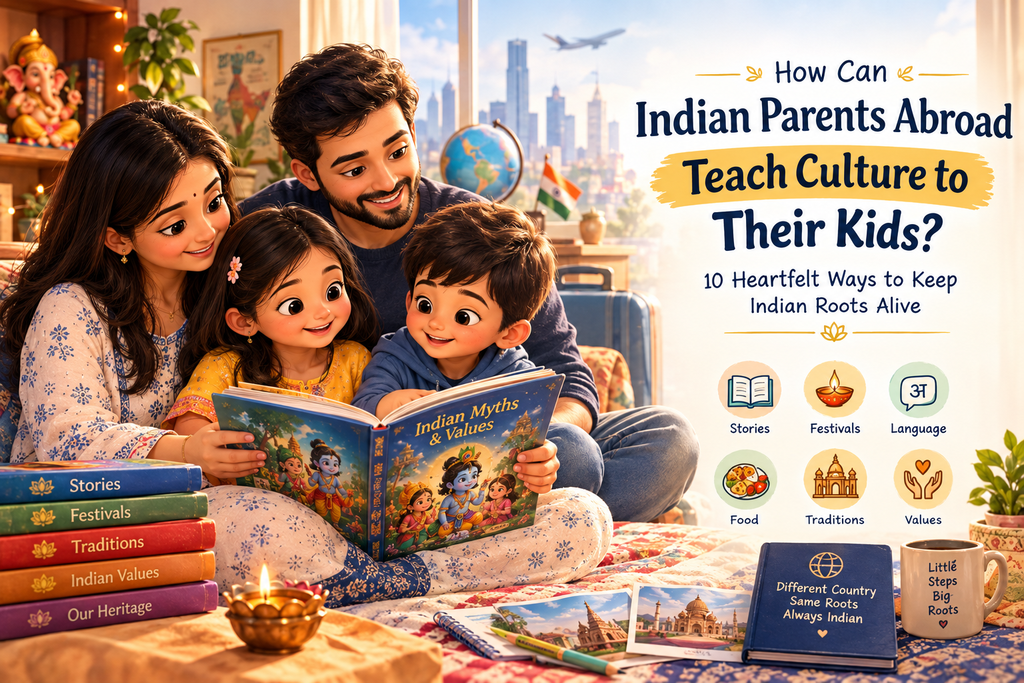
“Mom, why do we celebrate Diwali?”
“Dad, why does Grandma touch our feet?”
“Why do we speak a different language at home?”
For Indian parents living abroad, these questions can feel both heartwarming and challenging. You want your child to feel comfortable in the country where they are growing up, but you also want them to know the stories, traditions, languages, and values that shaped your family.
You may worry that your child knows more about superheroes than Shri Ram, more nursery rhymes than Indian folk songs, or more about international festivals than Diwali.
But here is the good news: You do not need to live in India to raise a child who feels connected to Indian culture.
Culture is not transferred through lectures. It develops through everyday moments—bedtime stories, family conversations, homemade food, festival celebrations, and the way children see their parents practise values.
Whether you live in the USA, UK, Canada, Australia, or another country, here are 10 practical and meaningful ways to introduce Indian culture to your children.
1. Start With Stories That Make Children Curious
Imagine your child sitting beside you at bedtime and asking:
“Why does Lord Ganesha have one tusk?”
That simple question can become the beginning of a beautiful cultural learning experience.
Children naturally enjoy stories filled with adventure, humor, emotion, and interesting characters. Instead of beginning with complicated religious explanations, introduce age-appropriate stories from Indian mythology and folklore.
You can share stories about:
- Lord Krishna’s childhood adventures
- Shri Ram and the Ramayana
- Lord Hanuman’s devotion and courage
- Lord Ganesha’s wisdom
- Goddess Durga’s strength
- Panchatantra and Indian folk tales
- Stories about kindness, honesty, and compassion
After telling a story, ask your child what they learned or which character they liked most.
For example, a story about Hanuman can lead to a conversation about courage and devotion. A Krishna story can introduce ideas about friendship, love, and responsibility.
Hindu mythology stories for kids are not only entertainment; they can also become meaningful starting points for cultural conversations.
At Tales of Dharma, our approach is to make traditional stories engaging and accessible for children through storytelling, activities, and creative learning.
2. Make Indian Festivals Feel Special at Home
When children grow up abroad, they may not experience the same festival atmosphere they would in India. They might miss large family gatherings, neighborhood celebrations, and the excitement of seeing homes decorated with diyas.
Parents can recreate meaningful experiences at home without organizing elaborate events.
For Diwali, children can:
- Make paper diyas.
- Help decorate the home.
- Learn the story of Shri Ram’s return to Ayodhya.
- Create rangoli designs.
- Prepare a simple traditional sweet.
- Talk about the symbolism of light and hope.
For Janmashtami, you could read a Bal Krishna story, make a simple Krishna craft, or prepare a traditional dish together.
For Ganesh Chaturthi, explain why families welcome Lord Ganesha and discuss qualities such as wisdom and humility.
The key is to explain the meaning behind the celebration, not just focus on new clothes, decorations, and sweets.
3. Speak Your Indian Language at Home
Language is one of the strongest ways to build a connection between children and their family heritage.
Research on immigrant families has found that using a heritage language with children can support their heritage-language development without necessarily harming their proficiency in the dominant language. A review also linked children’s heritage-language proficiency with parent–child communication and family outcomes, although results vary between families and circumstances.
You do not have to make language learning stressful.
Start with small steps:
- Speak Hindi or your regional language during everyday routines.
- Teach family relationship words.
- Read bilingual storybooks.
- Sing Indian lullabies.
- Encourage children to speak with grandparents.
- Use familiar phrases during meals and family conversations.
If your child responds in English, do not treat that as failure. Continue speaking naturally and celebrate their attempts.
The goal is to make your heritage language feel like a language of love, comfort, and connection.
4. Explain Why Indian Traditions Matter
Children often ask questions that adults may take for granted:
“Why do we touch elders’ feet?”
“Why do we light a diya?”
“Why do we ring temple bells?”
“Why do we apply tilak?”
Instead of replying, “Because that is what we do,” explain the meaning in simple language.
You might explain that touching an elder’s feet is traditionally associated with respect and receiving blessings. You can also mention that customs differ between families and regions.
When children understand the purpose of a tradition, they are more likely to connect with it.
Do not be afraid of questions. Cultural learning becomes stronger when children can ask, discuss, and explore ideas without feeling embarrassed.
5. Bring Indian Food Into Everyday Family Life
Ask your child which Indian food they enjoy most. Maybe it is dosa, rajma chawal, aloo paratha, idli, poha, or homemade kheer.
Food can become an enjoyable way to teach children about Indian culture and family history.
Invite your child into the kitchen to:
- Roll a small roti.
- Wash vegetables.
- Prepare a simple snack.
- Learn a family recipe.
- Decorate sweets during festivals.
- Ask grandparents about traditional dishes.
Tell them where a recipe comes from and when your family usually prepares it.
You can say, “Your grandmother used to make this during festivals,” or “This is a dish your grandfather loved when he was young.”
These little stories help children understand that food is connected to memories, regions, celebrations, and family relationships.
6. Keep Grandparents and Relatives Part of Their Lives
For many Indian families abroad, distance from grandparents is one of the biggest challenges.
Your child may not be able to visit India regularly, but technology can help maintain relationships.
Try scheduling regular video calls where grandparents:
- Tell childhood stories.
- Explain festival traditions.
- Teach a family song.
- Share stories about India.
- Show old photographs.
- Talk about family recipes.
Instead of asking children only to “say hello,” give them something interesting to discuss.
For example:
“Ask Nani what Diwali was like when she was a child.”
“Ask Dada about the games he played growing up.”
Personal stories often make culture more relatable than formal lessons. They help children understand that Indian heritage is connected to real people they love.
7. Introduce Indian Books and Creative Activities
Every child learns differently. Some enjoy reading, while others prefer drawing, colouring, games, or animated videos.
You can use a combination of resources to teach Indian culture to children:
- Hindu mythology books
- Indian history books for kids
- Printable colouring pages
- Festival activity sheets
- Traditional music
- Storytelling videos
- Cultural crafts
For younger children, visual storytelling can make unfamiliar names and traditions easier to understand.
A colouring activity featuring Krishna, Hanuman, Ganesha, or a traditional festival can become an opportunity to explain the character and their story.
Choose content that is age-appropriate, engaging, and respectful of different cultural and religious traditions.
8. Teach Indian Values Through Your Own Actions
Children learn from what parents do—not only from what parents say.
If you want to teach respect, demonstrate respectful communication. If you want to teach kindness, show compassion toward others. If you want to teach gratitude, practise it as a family.
Indian traditions often provide opportunities to discuss values such as:
- Respect
- Compassion
- Honesty
- Gratitude
- Responsibility
- Self-discipline
- Service
- Family connection
For example, after reading a story about Shri Ram, you could ask, “What does this story teach us about keeping promises?”
Do not expect children to understand every lesson immediately. Repeated conversations and everyday examples help values become familiar.
9. Help Children Feel Proud Without Making Them Feel Different
Children growing up abroad may sometimes feel caught between cultures. They may speak one language at school and another at home. They may celebrate different festivals from their friends or have questions about their identity.
Parents can help by creating a positive environment around cultural differences.
Encourage your child to share Indian traditions with friends when they feel comfortable. Let them explain Diwali, Indian food, traditional clothing, or a festival activity in their own words.
At the same time, avoid suggesting that other cultures are inferior. Children can be proud of their Indian heritage while appreciating the culture of the country where they live.
Cultural identity does not have to be a choice between two worlds. A child can develop a sense of belonging in multiple cultural environments.
10. Create a Simple Weekly Indian Culture Routine
You do not need to plan a complicated cultural curriculum. Consistency matters more than perfection.
Try this simple weekly routine:
| Day | Activity |
|---|---|
| Monday | Learn one Indian word |
| Tuesday | Read a short mythology story |
| Wednesday | Listen to an Indian song |
| Thursday | Discuss one tradition |
| Friday | Speak with grandparents |
| Saturday | Prepare an Indian dish |
| Sunday | Watch or read a cultural story together |
You can adjust this routine according to your family’s schedule and your child’s age.
Research on heritage-language development highlights the importance of actual language use and home literacy practices, rather than relying only on parent’s intentions to preserve culture.
Even 10–15 minutes of meaningful engagement can become a valuable family habit.
Common Challenges Indian Parents Face Abroad
What if my child is not interested in Indian culture?
Do not force every activity. Start with your child’s interests. If they enjoy superheroes, introduce Hanuman stories. If they enjoy art, try rangoli or mythology colouring pages. If they love music, explore Indian songs.
What if my child does not speak our language?
Begin with simple words and everyday conversations. Encourage effort rather than demanding fluency. Use books, songs, and conversations with relatives to create regular exposure.
What if I do not know enough about Indian traditions?
Learn alongside your child. You can explore reliable books, speak with elders, and research the background of a tradition together. It is perfectly acceptable to say, “I do not know, but let us find out.”
How can I teach Hinduism without making it feel forced?
Use stories, conversations, and everyday examples. Explain traditions respectfully and allow children to ask questions. Focus on understanding rather than fear or pressure.
Frequently Asked Questions
1. How can Indian parents abroad teach Indian culture to their children?
Parents can introduce Indian culture through Hindu mythology stories, Indian festivals, traditional food, regional languages, family traditions, music, crafts, and conversations with grandparents.
2. What are the best Indian culture activities for kids?
Popular activities include rangoli-making, festival crafts, Indian cooking, mythology colouring pages, storytelling, traditional music, and learning simple words in an Indian language.
3. How can I teach Hindu mythology to children living abroad?
Begin with short, age-appropriate stories about Krishna, Hanuman, Ganesha, Shri Ram, and other figures. Explain the values and lessons through simple conversations and creative activities.
4. Why is teaching Indian culture important for children abroad?
Cultural learning can help children understand their family history, develop connections with relatives, explore their heritage language, and build a sense of cultural identity. Each child’s experience will be different.
5. Can my child learn Indian culture without visiting India?
Yes. Children can learn through books, festivals, food, music, family conversations, cultural events, online resources, and regular interaction with relatives.
6. How do I balance Indian culture with the culture of the country where we live?
Encourage children to appreciate both. Teach them about Indian traditions while supporting their participation in school and community life. Cultural learning can include multiple identities and experiences.
7. How early should parents start teaching Indian culture?
Parents can begin with simple stories, songs, family words, and everyday traditions during early childhood. Activities should be adapted to the child’s age and interests.
Final Thoughts: Culture Begins With Small Moments
One day, your child may be far from home and suddenly recognize a familiar bhajan. They may explain Diwali to a friend, ask their grandmother for a story, or pick up a book about Krishna on their own.
Those moments may seem small, but they are meaningful.
You do not need to teach your child every Indian tradition in one year. You simply need to create regular opportunities for curiosity, connection, and understanding.
Read one story. Celebrate one festival. Learn one word. Call one grandparent.
Because Indian culture is not only something children inherit—it is something families experience, practise, and pass forward together.
At Tales of Dharma — Stories That Build Sanskar, we believe that every meaningful story can help children connect with Indian mythology, cultural heritage, and timeless values.
Stories today. Values for life.
for ore updates like this check: www.talesofdharma.com
for best books for kids in india you can buy Tales of Dharma books which are also available on Amazonhttps://amzn.in/d/08btjbMQ