
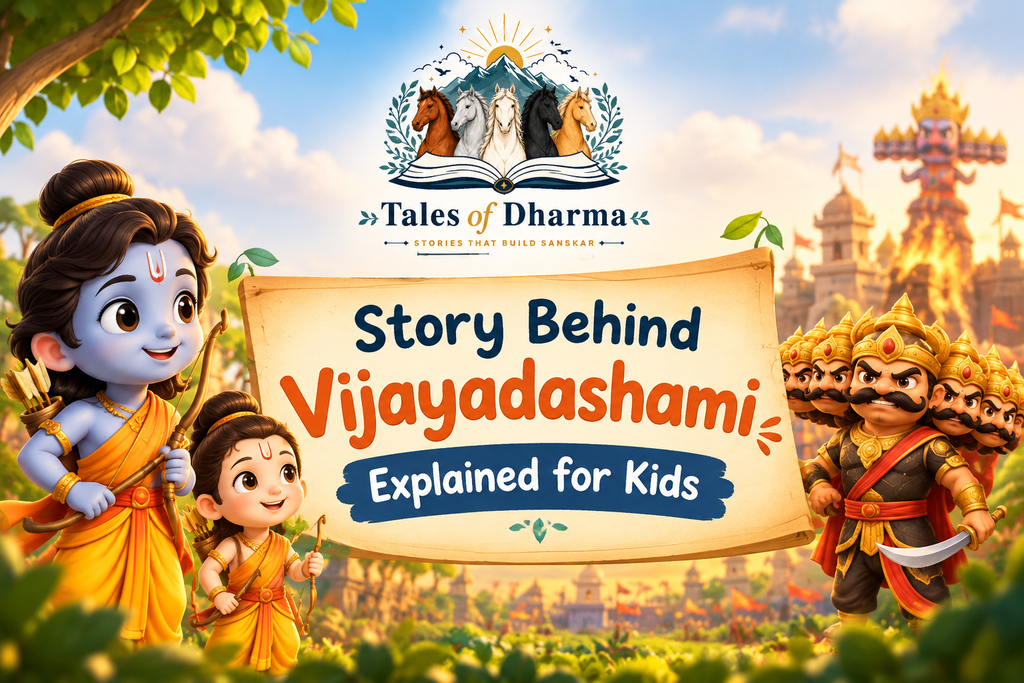
Have you ever wondered why people burn a huge effigy of Ravana on Dussehra?
Why does everyone say “Jai Shri Ram”?
And why do children get so excited when they see Ravana, Kumbhakarna, and Meghnada standing tall in a field?
Dussehra is much more than a festival of fireworks, fairs, and Ravana effigies.
It is a festival about good overcoming evil, truth overcoming falsehood, and courage overcoming fear.
But how do we explain this beautiful meaning to a child?
Let’s turn the story of Dussehra into one they will actually remember.
What Is Dussehra?
Dussehra, also called Vijayadashami, is one of the important Hindu festivals celebrated across India.
The word Vijayadashami can be understood as “the tenth day of victory.”
It is celebrated on the tenth day of the Hindu month of Ashwin, after the nine days of Navratri.
For many families, Dussehra is connected with the story of Lord Rama defeating Ravana in the Ramayana.
But there is a deeper lesson hidden inside this celebration.
Dussehra reminds children that our choices matter.
Being powerful is not enough.
Being clever is not enough.
What matters is how we use our strength, knowledge, and abilities.
The Story of Lord Rama and Ravana
To understand why we celebrate Dussehra, children first need to know the story behind it.
Long ago, Lord Rama, along with Sita Maa and his brother Lakshmana, lived in the forest during their exile.
Then something terrible happened.
Ravana, the powerful king of Lanka, abducted Sita.
Lord Rama decided to rescue her.
But he couldn’t do it alone.
He was joined by many brave allies, including Hanuman ji and the Vanara army.
Hanuman ji crossed the ocean, found Sita Maa in Lanka, and carried Rama’s message of hope to her.
A great battle followed between Rama’s army and Ravana’s forces.
After a long and difficult battle, Lord Rama defeated Ravana.
This victory is remembered on Dussehra or Vijayadashami.
Why Did Lord Rama Fight Ravana?
This is an important question to explain to children.
Ravana was not simply a character who was “bad” because he had ten heads.
He was described in the Ramayana as being extremely knowledgeable and powerful.
He was a great scholar and a devoted worshipper of Lord Shiva.
But his pride, arrogance, and misuse of power led him toward destruction.
And that’s where the real lesson begins.
A person can have knowledge but still make wrong choices.
A person can have power but misuse it.
A person can be talented but allow pride to control them.
Dussehra teaches children that good character is more important than power or intelligence alone.
Why Does Ravana Have 10 Heads?
Children often ask this question!
The ten heads of Ravana are commonly interpreted symbolically in different traditions.
They can represent negative qualities or human weaknesses such as anger, pride, greed, attachment, jealousy, and ego.
Different traditions give different interpretations, so parents can explain the idea simply:
“Ravana’s ten heads remind us that we all have weaknesses inside us. The real victory is learning to control them.”
This makes Dussehra personal for a child.
Instead of simply thinking, “Rama defeated Ravana,” a child can ask:
“What is my Ravana?”
Maybe it is anger.
Maybe it is lying.
Maybe it is being jealous of a sibling.
Maybe it is refusing to share.
Maybe it is spending too much time on screens instead of doing something meaningful.
Suddenly, Dussehra becomes a lesson they can understand in their own life.
Why Do We Burn Ravana’s Effigy on Dussehra?
One of the most exciting parts of Dussehra for children is watching a giant Ravana effigy go up in flames.
But instead of telling children only that “Rama killed Ravana,” parents can use the moment to teach something deeper.
The burning of Ravana’s effigy can be understood as a symbolic reminder to overcome negative qualities.
You can ask your child:
“If you could burn away one bad habit today, which one would it be?”
Maybe your child says:
“I get angry quickly.”
“I don’t listen.”
“I fight with my brother.”
“I don’t want to share.”
“I tell lies sometimes.”
That’s a wonderful opportunity.
Tell them:
“Then this Dussehra, let’s try to defeat that habit together.”
Now the festival becomes a family activity rather than simply something children watch.
Why Is Dussehra Called Vijayadashami?
The name itself carries a beautiful meaning.
Vijaya means victory.
Dashami refers to the tenth lunar day.
So, Vijayadashami means the tenth day of victory.
The festival is associated with victory in different Hindu traditions.
In many parts of India, it commemorates Lord Rama’s victory over Ravana.
In other traditions, Vijayadashami is associated with Maa Durga’s victory over Mahishasura.
This is one reason Dussehra has different celebrations across India.
The stories may look different, but the central idea of dharma overcoming adharma remains important.
Dussehra and Maa Durga
In many parts of India, especially eastern India, Vijayadashami comes at the end of Durga Puja.
Maa Durga is worshipped as the powerful form of the Divine Mother who defeats the demon Mahishasura.
This gives children another beautiful way to understand the festival:
Dussehra celebrates the victory of righteousness over wrongdoing.
Whether a family connects the festival with Rama and Ravana, Maa Durga and Mahishasura, or both traditions, children can learn that courage and righteousness matter.
What Does Dussehra Teach Children?
Dussehra has many lessons that parents can bring into everyday life.
1. Goodness Requires Courage
Doing the right thing isn’t always easy.
Sometimes we have to be brave enough to stand up for what is right.
2. Pride Can Become Our Weakness
Ravana had knowledge and power, but pride affected his choices.
Children can learn that being talented should make us humble, not arrogant.
3. Everyone Needs Good Friends
Lord Rama had the support of Hanuman ji, Sugriva, Jambavan, Lakshmana, and many others.
Good people can help us face difficult situations.
4. Mistakes Should Teach Us
Dussehra can encourage children to look at their own habits.
Instead of asking, “Who is the bad person?”
Ask:
“What can I improve about myself?”
5. Victory Is Not Only About Defeating Someone
The deeper victory can be the victory over our own anger, jealousy, laziness, dishonesty, or ego.
And that is a lesson children can carry long after the festival ends.
How Can Parents Explain Dussehra to a Child?
Keep it simple.
You don’t need to tell a young child the entire Ramayana in one sitting.
Try this:
“Dussehra is the festival of victory. We remember how Lord Rama defeated Ravana and rescued Sita Maa. It teaches us that truth and goodness should win over wrongdoing. When we see Ravana burn, we can also remember to let go of our own bad habits.”
For younger children, turn the lesson into a question:
“What is one habit you want to defeat this Dussehra?”
It could become a wonderful family conversation.
5 Fun Dussehra Activities for Kids
Want to make Dussehra meaningful instead of simply watching the celebration?
Try these activities at home.
1. My Ten Habits Activity
Draw a simple ten-headed Ravana.
On each head, write a negative habit:
- Anger
- Lying
- Jealousy
- Greed
- Laziness
- Ego
- Fighting
- Teasing
- Not sharing
- Disrespect
Then let your child choose one habit to work on.
2. Rama’s Good Qualities
Ask your child:
“What qualities do you think Lord Rama had?”
Write down their answers.
They may say:
Kindness.
Courage.
Truthfulness.
Respect.
Patience.
Responsibility.
This turns mythology into a character-building activity.
3. Tell the Ramayana Together
Instead of playing another cartoon, spend 10–15 minutes telling your child one part of the Ramayana.
You could begin with:
“Once upon a time, there was a prince named Rama…”
Let your child ask questions.
Those little questions often become the most memorable part of the story.
4. Make a Dussehra Story Wheel
Create simple drawings of:
Rama → Sita → Hanuman → Lanka → Battle → Victory
Let your child arrange them in the correct order and retell the story.
5. Make a “Good Habit Promise”
Ask every family member to choose one habit they want to improve.
For example:
“This Dussehra, I will try to control my anger.”
“This Dussehra, I will speak more kindly.”
“This Dussehra, I will spend less time on screens and more time with my family.”
Now Dussehra becomes something the whole family participates in.
A Simple Dussehra Message for Kids
You can tell your child:
“Dussehra reminds us that no matter how difficult life becomes, we should continue choosing truth, courage, kindness, and dharma. Ravana’s biggest weakness was not his ten heads. It was allowing pride and wrong choices to control him. Our biggest victory is learning to control our own weaknesses.”
That is a lesson worth remembering all year.
Why Should Children Know the Story Behind Dussehra?
Children see festivals everywhere.
They see decorations.
They hear mantras.
They watch processions.
They see giant Ravana effigies.
But when they know the story behind the festival, the celebration becomes much more meaningful.
Instead of simply knowing:
“We burn Ravana on Dussehra.”
They begin to understand:
“Dussehra reminds me to choose good over bad.”
And perhaps years later, when they see a Ravana effigy burning, they won’t only remember the fireworks.
They’ll remember the story their parents told them.
Because the stories children hear today can become the values they carry tomorrow.
Frequently Asked Questions About Dussehra
Why do we celebrate Dussehra?
Dussehra, or Vijayadashami, celebrates the victory of good over evil and is traditionally associated in many parts of India with Lord Rama’s victory over Ravana in the Ramayana.
What is the story of Dussehra for kids?
The story of Dussehra for children centers on Lord Rama’s journey to rescue Sita Maa from Ravana. With the help of Lakshmana, Hanuman ji, and the Vanara army, Rama fought Ravana and ultimately defeated him.
Why is Ravana burned on Dussehra?
Ravana’s effigy is burned as a symbolic representation of the victory of righteousness over wrongdoing. It can also remind us to overcome negative qualities such as pride, anger, greed, and jealousy.
What is the meaning of Vijayadashami?
Vijayadashami means the tenth day of victory. “Vijaya” means victory and “Dashami” refers to the tenth lunar day.
Why does Ravana have ten heads?
Ravana is traditionally depicted with ten heads. Different traditions interpret them symbolically in different ways, including as representations of various human weaknesses and negative qualities.
Is Dussehra the same as Vijayadashami?
The terms Dussehra and Vijayadashami are commonly used for the same festival, although celebrations and associated traditions vary across different regions of India.
Is Dussehra connected to Navratri?
Yes. In many traditions, Vijayadashami marks the conclusion of the nine-day Navratri period. In several regions, it also follows the celebrations of Durga Puja.
What is the difference between Dussehra and Diwali?
Dussehra celebrates victory associated with Rama’s defeat of Ravana, while Diwali is a separate festival with several traditions and stories, including the return of Lord Rama, Sita, and Lakshmana to Ayodhya in the Ramayana tradition.
What can children learn from Dussehra?
Children can learn about courage, truthfulness, humility, self-control, kindness, responsibility, and the importance of making good choices.
How can parents teach Dussehra to young children?
Use a simple story rather than a long explanation. Tell them about Rama, Sita, Hanuman, and Ravana, then connect the story to everyday values such as honesty, kindness, controlling anger, and respecting others.
This Dussehra, Tell the Story — Don’t Just Celebrate It
Festivals become meaningful when children understand why we celebrate them.
So this Dussehra, before the fireworks begin, sit beside your child.
Tell them about Rama.
Tell them about Sita.
Tell them about Hanuman.
Tell them about Ravana.
And then ask one simple question:
“What is one thing you want to become better at this Dussehra?”
Because perhaps the most beautiful way to celebrate Vijayadashami is not only to watch Ravana burn outside…
but to help our children understand the goodness they can build inside themselves.
And that’s how an old story becomes a lifelong lesson.
Stories That Build Sanskar.
If you’re looking for more meaningful ways to introduce your child to Hindu stories, Indian culture, mantras, and timeless values, explore Tales of Dharma, where you’ll find thoughtfully created books and activity books for children. You can explore the collection on our website or find our books on Amazon.