Have you ever wondered why Maa Durga has so many different names?
During Navratri, you may hear names such as Maa Shailputri, Maa Brahmacharini, Maa Chandraghanta, Maa Kushmanda and Maa Kalaratri. But are these different goddesses, or are they different forms of the same Goddess?
The answer is fascinating.
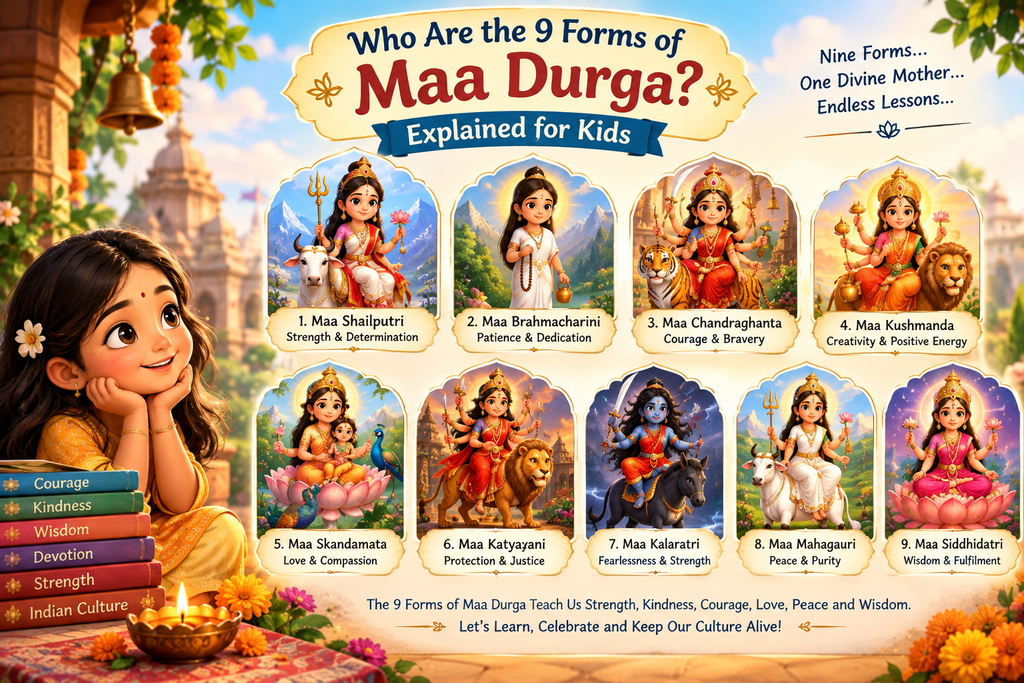
The nine forms of Maa Durga are traditionally known as the Navadurga, meaning the nine forms of Goddess Durga. Each form represents a different quality, such as strength, devotion, courage, wisdom, motherhood and spiritual power.
The Navadurga are especially worshipped during the nine days of Navratri. Each day of Navratri is traditionally associated with one form of Maa Durga.
For children, learning about the Navadurga is more than memorising nine names. Each form has a story, a unique appearance and a value that can become a wonderful life lesson.
So, let us meet all nine forms of Maa Durga.
1. Maa Shailputri: The Daughter of the Mountains
The first form of Maa Durga is Maa Shailputri.
The word “Shailputri” means “daughter of the mountain.” She is traditionally identified with Parvati, the daughter of Himavan, the king of the mountains.
Maa Shailputri is usually shown riding a bull and carrying a trident and lotus.
For children, her story can begin with a simple question:
“What would it be like to be strong like a mountain?”
Mountains are often seen as symbols of strength, stability and determination. Maa Shailputri represents these qualities.
Her story teaches children that being strong does not always mean being powerful or loud. Sometimes, true strength means staying steady when life becomes difficult.
Lesson for kids: Be strong, steady and determined.
2. Maa Brahmacharini: The Goddess of Devotion and Determination
The second form is Maa Brahmacharini.
Her story is connected with Parvati’s deep devotion and determination. According to traditional accounts, Parvati performed intense penance as she sought Shiva as her husband.
Maa Brahmacharini is generally depicted walking barefoot and carrying a rosary and a water pot.
Unlike the fierce images we sometimes associate with Goddess Durga, this form appears peaceful and calm.
Her story gives children an important lesson: some goals require patience.
Imagine learning something difficult. Perhaps a new language, musical instrument, sport or school subject. You may not become excellent at it in one day.
Maa Brahmacharini reminds us that dedication and patience can help us continue even when something takes time.
Lesson for kids: Stay patient and dedicated to your goals.
3. Maa Chandraghanta: The Goddess of Courage
The third form of Maa Durga is Maa Chandraghanta.
Her name comes from the crescent moon shaped like a bell, or ghanta, traditionally shown on her forehead.
Maa Chandraghanta is often depicted riding a tiger or lion and carrying several weapons.
Her appearance may look powerful, but the idea behind this form is especially meaningful for children.
Being courageous does not mean never feeling afraid.
It means having the strength to face challenges even when you are afraid.
A child who stands up for a friend, tells the truth when it is difficult or asks for help when something feels wrong is also showing courage.
Lesson for kids: Courage means doing what is right even when something feels difficult.
4. Maa Kushmanda: The Goddess of Creative Energy
The fourth form is Maa Kushmanda.
Her name is traditionally connected with the cosmic creation of the universe. In popular Hindu tradition, she is described as the Goddess whose divine smile brought light and energy to the universe.
She is often depicted with multiple arms holding various objects and riding a lion.
For children, Maa Kushmanda offers an interesting way to talk about creativity and positive energy.
Think about what happens when a child draws a picture, builds something with blocks or invents a new game.
A small idea can become something much bigger.
Lesson for kids: Creativity can begin with one small idea.
5. Maa Skandamata: The Loving Mother
The fifth form of Maa Durga is Maa Skandamata.
She is called Skandamata because she is the mother of Skanda, traditionally identified with Kartikeya.
She is often shown seated on a lotus while holding young Skanda in her lap.
This form beautifully represents motherhood, love, protection and compassion.
Children can easily connect with this idea because everyone understands the feeling of being cared for.
Maa Skandamata reminds us that strength can also look like kindness.
A parent protecting a child, a child helping a younger sibling or a friend comforting someone who is sad are all examples of caring behaviour.
Lesson for kids: Love and compassion are powerful forms of strength.
6. Maa Katyayani: The Warrior Goddess
The sixth form is Maa Katyayani.
She is traditionally described as a powerful warrior form of the Goddess. In Hindu traditions, Maa Katyayani is associated with the destruction of evil and the protection of righteousness.
She is commonly depicted riding a lion and carrying weapons.
Her story introduces children to an important concept: sometimes courage is needed to stand against wrongdoing.
But being a “warrior” does not mean fighting everyone.
For children, it can mean standing up for someone who is being bullied, speaking the truth or refusing to participate in something harmful.
Lesson for kids: Use your strength to protect what is right.
7. Maa Kalaratri: The Fearless Form of Durga
The seventh form is Maa Kalaratri.
Among the nine forms of Maa Durga, Kalaratri is one of the most powerful and fearsome in appearance. She is traditionally depicted with a dark complexion, flowing hair and a powerful form.
At first, children might find this form frightening.
But there is an important reason for her fierce appearance.
Maa Kalaratri represents the destruction of fear, darkness and negativity. Her story teaches that something that looks frightening does not necessarily represent evil.
In fact, the fierce form of the Goddess is traditionally understood as a protector.
For children, this can become a beautiful lesson about facing their fears.
Afraid of the dark?
Afraid of making mistakes?
Afraid of speaking in front of the class?
Courage can begin by facing one small fear at a time.
Lesson for kids: Do not let fear control you.
8. Maa Mahagauri: The Goddess of Peace and Purity
The eighth form of Maa Durga is Maa Mahagauri.
The name Mahagauri is associated with great brightness or purity.
She is traditionally depicted wearing white and riding a bull.
After the powerful form of Kalaratri, Mahagauri represents peace, calmness and purity.
This contrast is one of the most interesting aspects of the Navadurga.
The Goddess is not represented through only one quality. She can be powerful, peaceful, protective, compassionate and wise.
For children, Maa Mahagauri can represent the importance of having a calm mind and a kind heart.
Lesson for kids: Keep your heart kind and your mind peaceful.
9. Maa Siddhidatri: The Goddess of Wisdom and Spiritual Fulfilment
The ninth and final form of Maa Durga is Maa Siddhidatri.
The word “Siddhidatri” is associated with granting siddhis, or spiritual accomplishments and abilities.
She is traditionally depicted seated on a lotus and is associated with wisdom, spiritual knowledge and fulfilment.
After learning about the other eight forms, this final form gives the Navadurga story a meaningful conclusion.
The journey begins with strength, continues through devotion, courage, creativity, motherhood and protection, and ends with wisdom and spiritual fulfilment.
For children, the lesson can be simple:
Learning is a journey.
The more we learn, practise kindness and understand ourselves, the wiser we can become.
Lesson for kids: Keep learning and growing in wisdom.
The 9 Forms of Maa Durga at a Glance
| Navadurga Form | Simple Meaning | Lesson for Children |
|---|---|---|
| Maa Shailputri | Daughter of the Mountains | Strength and determination |
| Maa Brahmacharini | Goddess of devotion and penance | Patience and dedication |
| Maa Chandraghanta | Goddess of courage | Face challenges bravely |
| Maa Kushmanda | Goddess of creative energy | Creativity and positivity |
| Maa Skandamata | Loving mother of Skanda | Love and compassion |
| Maa Katyayani | Warrior form of Durga | Stand up for what is right |
| Maa Kalaratri | Fearless and powerful form | Overcome fear |
| Maa Mahagauri | Goddess of peace and purity | Kindness and calmness |
| Maa Siddhidatri | Goddess of spiritual fulfilment | Wisdom and learning |
Why Are There 9 Forms of Maa Durga?
The nine forms of Maa Durga are traditionally understood as different manifestations of the Goddess, each highlighting different aspects of divine feminine power.
The Navadurga are especially important during Navratri, when devotees worship a different form of Maa Durga on each of the nine days.
For children, the easiest way to understand the nine forms is to think of them as nine different qualities:
Strength. Devotion. Courage. Creativity. Love. Protection. Fearlessness. Peace. Wisdom.
Together, they create a beautiful picture of the many ways strength can appear.
How Can Parents Teach the Navadurga to Kids?
Trying to make children memorise nine names at once may not be very effective.
Instead, make it a story.
Teach one form each day during Navratri. Show your child a picture, tell a short story and ask one simple question.
For example:
“Today we learned about Maa Chandraghanta. When was the last time you were brave?”
This turns Navratri for kids into an interactive cultural learning experience.
You can also use:
- Navadurga colouring pages
- Durga stories for kids
- Navratri activity books
- Hindu mythology books
- Indian culture activities
- Simple devotional songs
- Storytelling videos
- Festival crafts
Children are more likely to remember cultural traditions when they experience them rather than simply memorise them.
Frequently Asked Questions About the 9 Forms of Maa Durga
What are the 9 forms of Maa Durga?
The nine forms of Maa Durga are Maa Shailputri, Maa Brahmacharini, Maa Chandraghanta, Maa Kushmanda, Maa Skandamata, Maa Katyayani, Maa Kalaratri, Maa Mahagauri and Maa Siddhidatri. Together, they are known as the Navadurga.
What is Navadurga?
Navadurga means the nine forms of Goddess Durga. These nine manifestations of Maa Durga are traditionally worshipped during the nine days of Navratri.
Which is the first form of Maa Durga?
Maa Shailputri is traditionally considered the first form of Maa Durga worshipped during Navratri.
Which is the ninth form of Maa Durga?
Maa Siddhidatri is the ninth form of Maa Durga and is traditionally worshipped on the ninth day of Navratri.
Which form of Durga is worshipped on Ashtami?
In many Navratri traditions, Maa Mahagauri is associated with the eighth day, Ashtami. However, specific customs can vary between regions and traditions.
Why is Maa Kalaratri considered a fierce form of Durga?
Maa Kalaratri is traditionally depicted in a fierce form and is associated with destroying darkness, fear and negative forces. Her fierce appearance represents protective power rather than evil.
How can I explain Navadurga to a 5-year-old?
Start with the simple idea that Maa Durga has nine traditional forms, and each form teaches a different quality. Use short stories and connect each form with a value such as courage, kindness, patience, strength or wisdom.
Is Navadurga the same as the nine avatars of Durga?
“Navadurga” refers specifically to the nine traditional forms of Maa Durga worshipped during Navratri. The term “avatar” is sometimes used informally, but “nine forms” or “Navadurga” is more precise in this context.
Final Thoughts
The story of the Navadurga is not simply a list of nine names.
It is a journey through different expressions of strength.
Maa Shailputri teaches determination. Maa Brahmacharini teaches patience. Maa Chandraghanta teaches courage. Maa Kushmanda represents creative energy. Maa Skandamata reminds us about love. Maa Katyayani represents protective strength. Maa Kalaratri teaches fearlessness. Maa Mahagauri represents peace. Maa Siddhidatri brings the journey toward wisdom and fulfilment.
That is what makes the 9 forms of Maa Durga so meaningful for children.
Instead of asking them to memorise the Navadurga, give them a story to remember.
One story.
One value.
One lesson.
And perhaps, one day, when your child sees a picture of Maa Durga during Navratri, they will not simply recognise the Goddess. They will remember the qualities she represents.
Tales of Dharma — Stories That Build Sanskar.
If you’re looking for more meaningful ways to introduce your child to Hindu stories, Indian culture, mantras, and timeless values, explore Tales of Dharma, where you’ll find thoughtfully created books and activity books for children. You can explore the collection on Amazon.