
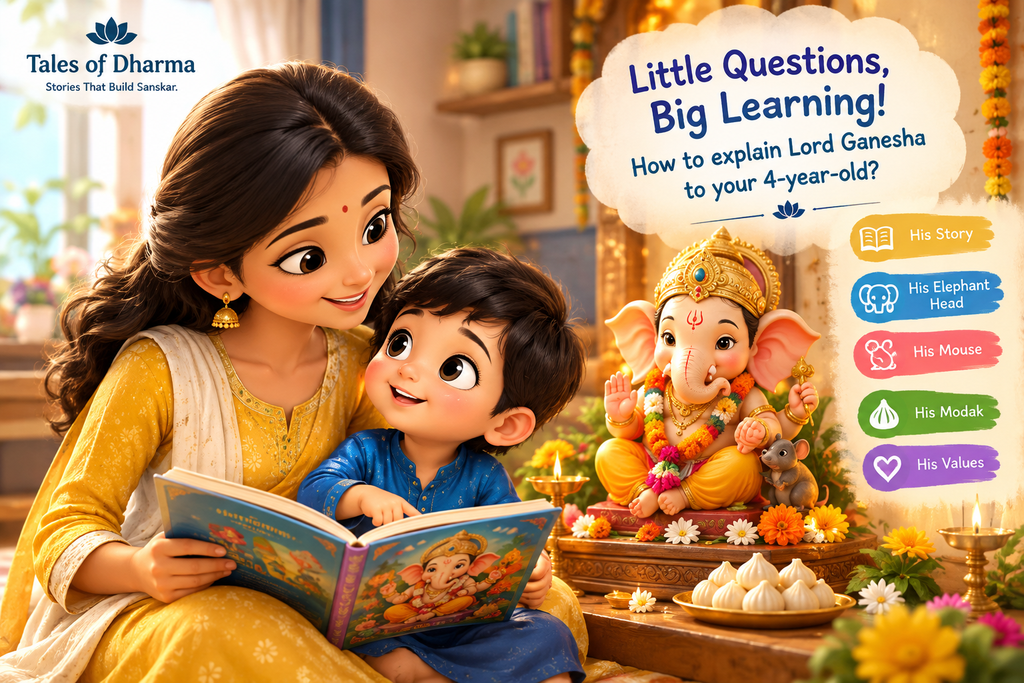
Explaining Hindu gods and stories to a 4-year-old can be surprisingly difficult.
A child may look at a picture of Lord Ganesha and immediately ask:
“Why does Ganesha have an elephant head?”
Or:
“Why does he have a mouse?”
“Why do we give him modak?”
“Is Ganesha a real person?”
These questions are wonderful opportunities to introduce children to Indian culture, Hindu mythology, family traditions, and meaningful stories in a way they can actually understand.
The key is simple: don’t try to explain everything at once. Tell a story.
For a 4-year-old, Ganesha doesn’t need to become a complicated lesson about mythology. He can become a lovable character through whom your child learns about wisdom, kindness, listening, courage, and respecting parents.
In this guide, we’ll explore how to explain Lord Ganesha to a 4-year-old, what to say about his elephant head, mouse, modaks, and Ganesh Chaturthi, and how to make learning about Ganesha fun.
Who Is Lord Ganesha? A 4-Year-Old-Friendly Explanation
Start with something very simple.
You can tell your child:
“Ganesha is a beloved Hindu deity. He has an elephant head, a big tummy, and a little mouse as his vehicle. People pray to Ganesha for wisdom and for help in overcoming obstacles.”
Then ask your child:
“Would you like to hear his story?”
Children naturally respond to stories. Instead of giving them a list of facts about Ganesha, let their curiosity guide the conversation.
You can introduce Ganesha as Maa Parvati’s beloved son and explain that his stories teach us important values.
How Was Ganesha Born?
The traditional story has different tellings across Hindu traditions, so for a 4-year-old, you can share a gentle version.
Tell your child:
“Once, Maa Parvati wanted someone to guard her door while she was inside. She created a little boy and gave him life. She named him Ganesha.”
Then continue:
“Maa Parvati told Ganesha to protect the door and not let anyone enter without her permission.”
A 4-year-old may immediately ask:
“Did Ganesha listen to his mother?”
You can say:
“Yes! Ganesha took his mother’s words very seriously.”
This creates an opportunity to talk about listening to parents and keeping promises.
Why Does Ganesha Have an Elephant Head?
This is probably one of the first questions children ask.
You don’t need to make the explanation frightening.
You can say:
“Ganesha had a difficult moment when he met Lord Shiva. There was a misunderstanding, and Ganesha lost his head. Maa Parvati was very upset. Lord Shiva then restored Ganesha’s life with an elephant’s head.”
For a young child, keep the explanation gentle and brief.
Then turn the story into something positive:
“And that’s how Ganesha became the beautiful elephant-headed deity we know today.”
You can also tell your child that elephants are often associated with qualities such as strength, wisdom, and patience.
Why Does Ganesha Have Big Ears?
This is a wonderful question to turn into a lesson.
Show your child a picture of Ganesha and ask:
“What do you notice about his ears?”
Your child may laugh and say:
“They’re huge!”
Then explain:
“Ganesha’s big ears remind us to listen carefully.”
You can make this interactive.
Ask:
“Should we listen when Mama or Papa is talking?”
“Should we listen when our friend is telling us something?”
This turns mythology into a practical lesson a 4-year-old can understand.
Why Does Ganesha Have a Mouse?
Children often find Mushak one of the most interesting parts of Ganesha’s story.
Tell them:
“Ganesha’s vehicle is a little mouse called Mushak.”
Then ask:
“How can such a big Ganesha ride such a tiny mouse?”
This can become a fun conversation.
You can explain that Ganesha and Mushak remind us that something small can still be important.
For children, this can become a beautiful message:
“Never think you are too small to do something meaningful.”
Why Does Ganesha Love Modak?
A plate of modaks is almost guaranteed to get a 4-year-old’s attention!
You can say:
“Modak is one of the sweets traditionally offered to Lord Ganesha. That’s why you often see Ganesha with a modak in his hand.”
Instead of simply saying “Ganesha loves sweets,” use it as an opportunity to introduce the festival.
You can ask:
“Would you like to make modaks with me?”
Cooking together can turn a mythology lesson into a family memory.
Why Do We Celebrate Ganesh Chaturthi?
A 4-year-old doesn’t need a complicated explanation of the entire festival.
Keep it simple:
“Ganesh Chaturthi is a special festival when people welcome Lord Ganesha, pray to him, decorate his idol, offer flowers and modaks, sing devotional songs, and celebrate with their families.”
You can show your child pictures of Ganesh Chaturthi celebrations and let them identify things they recognize.
Ask:
- “Can you find the flowers?”
- “Where is the diya?”
- “Can you find Ganesha?”
- “What sweet can you see?”
- “Can you hear the bells?”
This makes learning interactive.
What Does Ganesha Teach Children?
This is where the story becomes meaningful.
Instead of simply teaching children that Ganesha is a god they should pray to, you can help them understand the values associated with his stories.
1. Listen Carefully
Ganesha’s large ears can remind children to listen.
2. Respect Your Parents
His story provides an opportunity to discuss respecting and listening to parents.
3. Be Patient
Ganesha’s stories can introduce children to the importance of patience and thoughtful action.
4. Be Wise
Talk to your child about thinking before making a decision.
5. Don’t Give Up
Ganesha is commonly associated with overcoming obstacles.
Tell your child:
“When something feels difficult, don’t give up. Take a deep breath and try again.”
That’s a message a 4-year-old can use every day.
How to Make Ganesha Stories Fun for a 4-Year-Old
Don’t make the conversation feel like school.
Instead, turn it into play.
Try a Ganesha Story Session
Sit with your child and show them a picture of Ganesha.
Ask:
“Who do you think this is?”
Then let your child answer.
Follow with:
“Would you like to hear his story?”
Use different voices for characters, facial expressions, hand movements, and simple questions.
You can even pause during the story and ask:
“What do you think Ganesha will do next?”
This encourages your child to participate instead of simply listening.
5 Fun Ganesha Activities for 4-Year-Olds
Learning about Ganesha doesn’t have to happen only through books.
1. Ganesha Coloring
Give your child a simple Ganesha coloring page.
While they color, tell them a short Ganesha story.
2. Make a Ganesha Craft
Use paper, clay, or other child-safe craft materials to create a simple Ganesha.
3. Learn a Simple Chant
Introduce a short devotional chant such as:
“Ganpati Bappa Morya.”
Explain that people use it lovingly while celebrating Ganesha.
4. Make Modaks Together
If appropriate for your child’s age and your family tradition, prepare modaks together with adult supervision.
5. Ganesha Storytime
Set aside 10 minutes before bedtime for a Ganesha story.
You don’t need a long story.
One story + one picture + one question is enough.
What If My Child Asks Difficult Questions?
Four-year-olds can ask surprisingly complicated questions.
Don’t worry about having the perfect answer.
If your child asks:
“Why did this happen?”
You can say:
“That’s part of the traditional story. There are different versions of this story too. Would you like to hear another one?”
This teaches children that traditional stories can have different tellings while keeping the conversation open.
Most importantly, don’t overload your child with information.
At this age, curiosity matters more than memorization.
A Simple 2-Minute Ganesha Story for Your Child
Here’s a version you can tell at bedtime:
“Long ago, Maa Parvati created a little boy named Ganesha. She loved him very much and asked him to guard her door.
Ganesha promised his mother that he would protect the door.
One day, Lord Shiva came to the door. Ganesha did not know him and followed his mother’s instructions.
A misunderstanding took place, and Ganesha was hurt.
Maa Parvati was heartbroken. Lord Shiva then brought Ganesha back to life with the head of an elephant.
From that day, Ganesha became known for his elephant head, big ears, wisdom, and kind nature.
Ganesha also has a tiny mouse named Mushak as his vehicle.
And whenever you see Ganesha, remember: listen carefully, respect your parents, be kind, and don’t give up when something feels difficult.”
Then ask your child:
“What did you learn from Ganesha today?”
You may be surprised by the answer.
Why Storytelling Is Better Than Memorizing Fact
A child may quickly forget:
“Ganesha is the son of Shiva and Parvati.”
But they may remember:
“Ganesha listened to his mother.”
They may remember his little mouse.
They may remember the modak.
They may remember asking why he has an elephant head.
And most importantly, they may begin connecting stories with values.
That’s why storytelling can be such a natural way to introduce young children to Hindu mythology and Indian culture.
Frequently Asked Questions
How do I explain Lord Ganesha to a 4-year-old?
Keep the explanation simple and story-based. Introduce Ganesha as a beloved Hindu deity and share a short version of his birth story, his elephant head, his mouse vehicle, and the values associated with his stories.
What should I tell my child about Ganesha’s elephant head?
Explain the traditional story gently and avoid graphic details. Tell your child that after a difficult misunderstanding, Ganesha was given an elephant’s head and became the beloved elephant-headed deity.
Why does Ganesha have a mouse?
Ganesha’s vehicle is traditionally called Mushak. You can use the mouse to teach children that even something small can have an important role.
Why do children celebrate Ganesh Chaturthi?
Ganesh Chaturthi is a festival celebrating and honoring Lord Ganesha. Families may pray, decorate, sing, prepare traditional foods, tell stories, and participate in community celebrations.
What can children learn from Lord Ganesha?
Ganesha’s stories can introduce children to ideas such as listening carefully, respecting parents, patience, wisdom, perseverance, and overcoming challenges.
What is the best age to introduce Hindu mythology to children?
There is no single required age. Even young children can enjoy simple stories, pictures, songs, festivals, and family traditions when they are presented in an age-appropriate way.
How can I make Ganesha stories interesting for my child?
Use colorful pictures, expressive storytelling, questions, coloring pages, crafts, songs, and simple activities. Let your child ask questions rather than turning the story into a lesson they have to memorize.
Final Thoughts
Teaching a 4-year-old about Ganesha doesn’t require complicated explanations.
Start with a story.
Show them a picture.
Let them ask questions.
Color Ganesha together.
Make a modak.
Sing a simple chant.
And most importantly, connect the story to something they can understand in everyday life.
“Listen carefully.”
“Respect your parents.”
“Be kind.”
“Don’t give up.”
These are simple lessons, but they can become part of a child’s understanding of the stories and traditions they grow up with.
Because when children don’t just hear a story but experience it through questions, play, coloring, family conversations, and celebration, the story can become something they remember long after the festival is over.
This Ganesh Chaturthi, don’t just tell your child who Ganesha is. Tell them his story. 🌸
Radhe Radhe.
for more updated like this check- Tales of Dharma http://www.talesofdharma.com
to buy best kids books for drawing and coloring you must check- Amazonhttps://amzn.in/d/04qTrrHD