
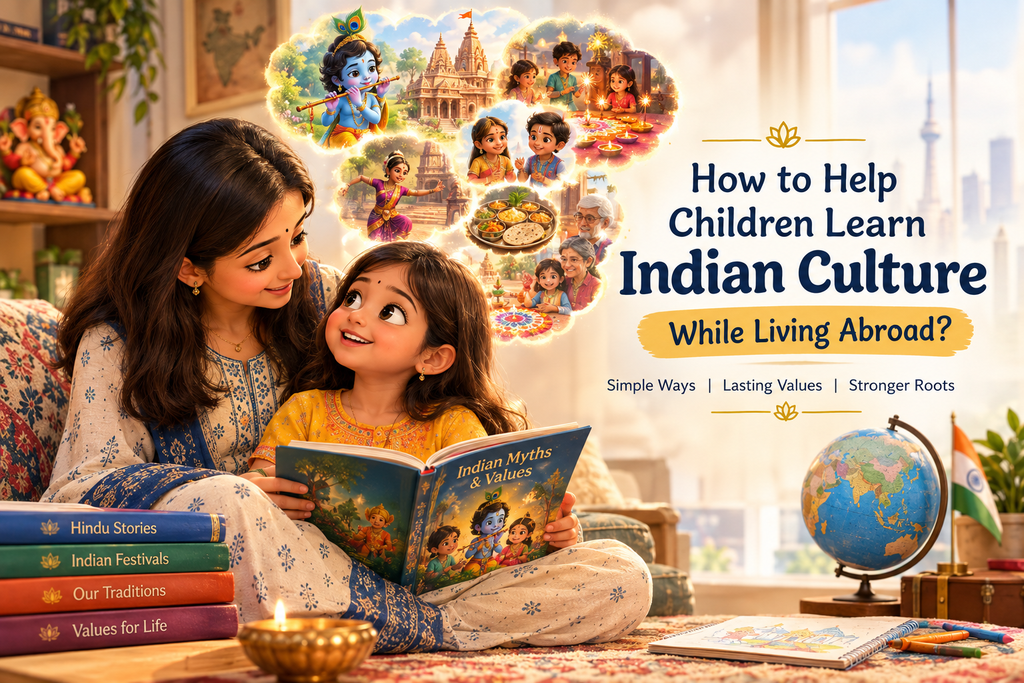
Raising children abroad comes with many beautiful opportunities. Children experience different cultures, learn new languages, make friends from diverse backgrounds, and develop a broader understanding of the world.
However, many Indian parents living outside India also wonder:
“How can I help my child stay connected to Indian culture?”
When children grow up in countries such as the United States, the United Kingdom, Canada, Australia, or other parts of the world, they may not experience Indian festivals, family traditions, regional languages, and cultural celebrations every day.
This does not mean they have to lose their connection to their roots.
Indian culture can be introduced through everyday experiences, meaningful conversations, stories, food, celebrations, and family relationships. The goal is not to force children to follow every tradition but to help them understand their heritage with curiosity, love, and pride.
In this article, we will explore 12 practical ways parents can teach Indian culture to children living abroad.
1. Introduce Indian Culture Through Stories
Stories are one of the most engaging ways to teach children about Indian traditions and values.
Children may not always enjoy listening to long explanations about culture, religion, or history. But they naturally connect with interesting characters, adventures, emotions, and exciting storytelling.
Introduce your child to age-appropriate stories about:
- Lord Krishna and his childhood adventures
- Shri Ram and the Ramayana
- Lord Hanuman and his devotion
- Lord Ganesha and his wisdom
- Goddess Durga and her courage
- Indian folk tales and Panchatantra stories
- Stories about kindness, honesty, courage, and respect
For example, instead of simply telling your child to be helpful, share a story that shows how even a small act of service can make a difference.
Hindu mythology stories for kids can help children discover Indian traditions while learning important life values.
Choose stories that are suitable for your child’s age and explain cultural concepts in simple language.
2. Celebrate Indian Festivals at Home
Indian festivals offer a wonderful opportunity to introduce children to Indian culture while living abroad.
You do not need to organise a large celebration every time. Even a small family activity can help children understand the meaning behind a festival.
Some festivals you can celebrate include:
- Diwali
- Holi
- Janmashtami
- Ganesh Chaturthi
- Navratri
- Raksha Bandhan
- Makar Sankranti
- Dussehra
- Ram Navami
During Diwali, children can help decorate the home, make paper diyas, learn about Lord Rama’s return to Ayodhya, and understand the importance of light and hope.
During Janmashtami, you can share stories about Bal Krishna, prepare traditional food, and create a simple Krishna-themed craft.
Try to explain why a festival is celebrated, rather than focusing only on decorations, sweets, or new clothes. This makes celebrations more meaningful and encourages children to ask questions.
3. Teach Indian Languages Naturally
Language plays an important role in cultural identity and family connection.
If your family speaks Hindi, Tamil, Telugu, Bengali, Gujarati, Marathi, Punjabi, Malayalam, Kannada, or another Indian language, introduce it naturally in everyday life.
You can start with simple activities:
- Speak familiar words at home.
- Teach greetings and family relationship names.
- Read short bilingual stories.
- Sing traditional songs and lullabies.
- Watch age-appropriate stories in your regional language.
- Encourage children to speak with grandparents.
Do not make language learning feel like a stressful examination. Begin with simple words such as Namaste, Dadi, Nani, Prasad, and Dhanyavaad, depending on your family’s language and traditions.
The objective is to help children feel comfortable and connected—not to expect perfect fluency immediately.
4. Explain the Meaning Behind Indian Traditions
Children are naturally curious. They may ask questions such as:
- Why do we light a diya?
- Why do we touch elders’ feet?
- Why do we ring temple bells?
- Why do we apply tilak?
- Why do we fold our hands?
- Why do we offer flowers during prayer?
- Why do we say “Prasad”?
Instead of saying, “Because this is our tradition,” take a moment to explain the meaning in an age-appropriate way.
For example, you can explain that touching elders’ feet is traditionally associated with showing respect and receiving blessings. When explaining a practice, acknowledge that customs can vary among families and regions.
These conversations help children understand Indian traditions and cultural practices rather than simply memorising them.
Remember that it is acceptable to say, “Different families follow this tradition in different ways.” This encourages respectful learning and open-mindedness.
5. Make Indian Food Part of Everyday Life
Food is a powerful way to connect children with their heritage.
You can introduce Indian culture through familiar home-cooked meals and simple cooking activities. Invite your child to help prepare:
- Roti and sabzi
- Dal and rice
- Idli and dosa
- Poha
- Paratha
- Kheer
- Ladoo
- Regional family recipes
Explain where a dish comes from and when your family traditionally prepares it.
For instance, you might tell your child about a special dish made during Diwali or a family recipe passed down by grandparents.
Allow children to explore food without pressuring them to like everything. You can also combine Indian dishes with foods they already enjoy.
Cooking together creates memories and helps children develop a positive relationship with their cultural heritage.
6. Connect Children With Grandparents and Relatives
Living abroad can sometimes make it difficult for children to spend time with extended family in India. Regular communication can help maintain these relationships.
Encourage your child to:
- Video call grandparents.
- Listen to family stories.
- Ask relatives about their childhood.
- Learn traditional songs from elders.
- Hear stories about family traditions.
- Celebrate special occasions together online.
Grandparents often carry personal memories and cultural knowledge that children cannot learn from textbooks alone.
Ask grandparents to share stories about festivals, childhood games, village life, family customs, or memorable experiences.
These conversations can help children understand that culture is not only about rituals. It is also about relationships, memories, kindness, and shared experiences.
7. Use Indian Books, Activity Books, and Educational Resources
Children learn in different ways. Some enjoy reading, while others prefer colouring, crafts, puzzles, or videos.
Parents can introduce Indian culture through age-appropriate resources such as:
- Hindu mythology storybooks
- Indian history books for children
- Printable colouring pages
- Cultural activity books
- Indian festival worksheets
- Animated mythology stories
- Traditional music and rhymes
For younger children, colourful illustrations and short stories may be more effective than lengthy explanations.
At Tales of Dharma — Stories That Build Kansan, the aim is to make Indian mythology and cultural values accessible to children through engaging stories and creative activities.
When choosing educational resources, look for content that is age-appropriate, respectful, easy to understand, and aligned with the learning needs of your child.
8. Teach Cultural Values Through Everyday Actions
Indian culture includes many values that can be practised in daily life.
Some examples include:
- Respect for elders
- Compassion toward animals
- Gratitude
- Honesty
- Kindness
- Self-discipline
- Helping others
- Responsibility toward family and community
Rather than only explaining these values, demonstrate them through your own actions.
For example, if you want your child to learn respect, show respectful communication at home. If you want to teach gratitude, encourage your family to discuss one thing they are thankful for each day.
Stories from the Ramayana, Mahabharata, Panchatantra, and other Indian traditions can be used as conversation starters. Explain that stories may contain different interpretations and that children can ask questions.
Culture becomes more meaningful when children see its values in everyday life.
9. Introduce Indian Music, Dance, and Art
Creative activities can make learning Indian culture enjoyable.
Depending on your child’s interests, introduce:
- Classical music
- Folk songs
- Bharatanatyam
- Kathak
- Garbanzo
- Bhangra
- Indian painting styles
- Rangoli designs
- Traditional crafts
You do not need to enrol your child in multiple classes. Start with simple activities at home.
You could listen to Indian devotional music together, make a rangoli design using paper, or learn a few traditional dance movements during a festival.
Let children explore different regional traditions and discover what they enjoy. India has diverse languages, art forms, cuisines, and customs, so cultural learning can be broad and creative.
10. Plan Visits and Cultural Experiences
If possible, take your child to India or attend Indian cultural events in your local community.
Useful experiences may include:
- Visiting grandparents and relatives
- Exploring historical sites
- Visiting temples or cultural centres
- Attending Indian community celebrations
- Participating in language or cultural classes
- Visiting museums featuring Indian history
- Meeting other Indian families
If travelling to India is not possible every year, look for local community events. Many cities abroad have Indian associations, cultural organizations, and festival gatherings.
Explain what your child is seeing and encourage them to ask questions.
Real-world experiences can make cultural learning memorable, especially when children can connect what they see with stories and traditions they have already learned.
11. Avoid Making Culture Feel Like a Burden
One of the most important things parents can do is create a positive learning environment.
Children may have questions about differences between their home culture and the culture of the country where they live. They may also feel unsure about speaking a regional language, wearing traditional clothing, or explaining their customs to friends.
Listen to their questions without immediately judging them.
Avoid using culture as a way to shame children or compare them with others. Instead, explain that cultural identity can include many experiences.
A child can appreciate Indian traditions while also learning about other cultures. They can celebrate Diwali, enjoy international friendships, and participate in activities at school.
Cultural connection grows through understanding and trust—not fear or pressure.
12. Make Indian Culture a Regular Part of Family Life
Cultural learning does not have to be limited to festivals or special occasions.
Small, consistent activities can make a meaningful difference:
- Read one Indian story each week.
- Teach a new regional word.
- Prepare a traditional meal together.
- Discuss one cultural tradition.
- Watch an age-appropriate mythology story.
- Speak with grandparents.
- Practise gratitude or kindness.
- Explore one Indian art form each month.
You do not need to do everything at once. Choose activities that fit your family’s schedule and your child’s interests.
A simple weekly routine can help children develop familiarity with their heritage without feeling overwhelmed.
How Can Parents Teach Hinduism to Children Living Abroad?
Parents who want to introduce Hinduism to their children can begin with simple, meaningful experiences.
Start with stories about deities and their values, explain the meaning of basic traditions, and encourage children to ask questions. Introduce prayer in a gentle way and allow children to understand its purpose according to the family’s beliefs.
You can also explore:
- Krishna stories for kids
- Ramayana stories for children
- Ganesha stories
- Hanuman stories
- Hindu festivals and their meanings
- Simple mantras and their translations
- Indian temples and cultural traditions
The approach should be age-appropriate and respectful. Children may understand religious and philosophical concepts gradually as they grow.
Common Challenges When Teaching Indian Culture Abroad
1. “My child prefers the local culture.”
This is natural. Children are influenced by their school, friends, media, and surroundings. Instead of criticising their interests, introduce Indian culture through activities they already enjoy, such as animation, games, music, crafts, and storytelling.
2. “My child does not speak our Indian language.”
Start with small conversations and familiar words. Use bilingual books, songs, and regular interaction with relatives. Avoid creating unnecessary pressure.
3. “We do not have time for cultural activities.”
Begin with five to ten minutes a day or one activity per week. Small routines can be easier to maintain than complicated schedules.
4. “My child keeps asking difficult questions.”
Encourage curiosity. If you do not know the answer, say so and explore the topic together using reliable, age-appropriate resources.
Frequently Asked Questions
1. How can I teach Indian culture to my child living abroad?
You can teach Indian culture through Hindu mythology stories, Indian festivals, traditional food, regional languages, music, family traditions, cultural activities, and conversations with grandparents.
2. How do I keep my child connected to Indian roots?
Create regular opportunities to experience Indian traditions at home. Read stories, celebrate festivals, teach family languages, and encourage meaningful relationships with relatives.
3. What are the best Indian culture activities for kids?
Popular activities include rangoli-making, Indian festival crafts, traditional cooking, storytelling, colouring pages, classical music, folk dances, and learning Indian languages.
4. How can Hindu stories help children learn Indian values?
Hindu stories introduce children to characters, challenges, and lessons related to courage, devotion, honesty, responsibility, and kindness. Parents can discuss the meaning of each story in an age-appropriate way.
5. Should parents force children to follow every Indian tradition?
Cultural learning is generally more meaningful when children are encouraged to understand traditions and ask questions. Parents can explain family practices while respecting the child’s age, curiosity, and individual development.
6. Can children learn Indian culture without visiting India?
Yes. Children can explore Indian culture through books, stories, festivals, food, language, community events, family conversations, music, and educational activities.
Final Thoughts
Helping children learn Indian culture while living abroad is not about recreating every aspect of life in India. It is about creating meaningful connections with their heritage through everyday experiences.
A story before bedtime, a conversation with grandparents, a Diwali diya, a traditional meal, or a new word in a regional language can become a lasting memory.
As parents, you can introduce your children to Indian culture with patience, warmth, and curiosity. Let them explore their roots while also appreciating the diverse world around them.
Because when children understand their heritage, they carry not only traditions but also stories, values, and memories into the future.
At Tales of Dharma — Stories That Build Sanskar, we believe that meaningful stories can help families introduce children to Hindu mythology, Indian culture, and timeless values in an engaging way.
Stories That Build Sanskar.
for more updates check- http://www.talesofdharma.com
If you’re looking for more meaningful ways to introduce your child to Hindu stories, Indian culture, mantras, and timeless values, explore Tales of Dharma, where you’ll find thoughtfully created books and activity books for children. You can explore the collection on our website or find our books on https://amzn.in/d/0aLu10iB