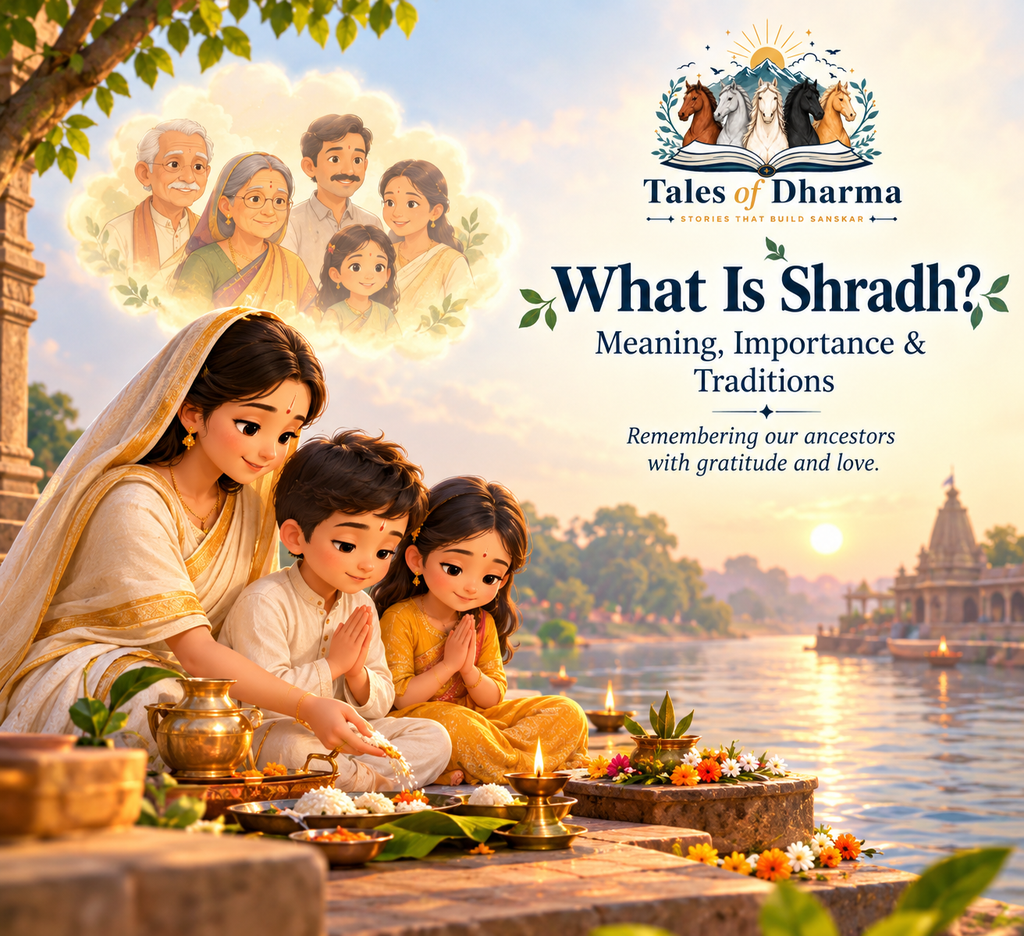
Have you ever heard your grandparents say, “Pitru Paksha mein Shradh karna chahiye”?
Or perhaps you’ve seen families preparing food, offering water, remembering ancestors, and visiting temples during these days.
A child may naturally ask:
“Why do we do this?”
“Who are our ancestors?”
“Why do we offer food and water to them?”
“Is Shradh a festival?”
Shradh can seem like a serious or complicated tradition, especially for children. But at its heart, it is about something every child can understand:
Remembering the people who came before us and expressing gratitude for what they gave our family.
Let’s understand the meaning, importance, and traditions of Shradh in a simple and meaningful way.
What Is Shradh?
Shradh, also spelled Shraddha, is a Hindu tradition of remembering and honoring deceased ancestors.
The word is connected with “shraddha,” meaning faith, sincerity, or heartfelt respect.
During Shradh, families traditionally remember their departed family members and perform rituals according to their family and regional traditions.
It is particularly associated with Pitru Paksha, a period traditionally dedicated to remembering ancestors.
Rather than thinking of Shradh only as a ritual, parents can explain it to children as a time for:
Remembrance.
Gratitude.
Respect.
Family.
And connection with our roots.
What Is Pitru Paksha?
Pitru Paksha is a period in the Hindu lunar calendar traditionally dedicated to honoring ancestors.
It is commonly observed for about 16 lunar days, beginning around the full moon period and continuing until Sarva Pitru Amavasya, although exact dates vary each year and regional calendars can differ.
During this period, many Hindu families perform Shradh or other ancestral remembrance rituals.
The word Pitru refers to ancestors.
So, in simple words:
Pitru Paksha is a time to remember and honor those who came before us.
Why Is Shradh Important?
Imagine a family tree.
At the very top are grandparents, great-grandparents, and generations before them.
Because of them, our family traditions, stories, names, recipes, values, and memories have continued from one generation to another.
Shradh provides a traditional way of saying:
“We remember you. We respect you. We are grateful for what you gave our family.”
For children, this can become a beautiful lesson in gratitude.
We often teach children to say “thank you” when someone gives them something.
Shradh takes that idea across generations.
It reminds us to be thankful not only to the people we see today, but also to those whose lives helped shape our family.
What Happens During Shradh?
Shradh traditions can differ depending on the family’s customs, region, community, and religious tradition.
Common practices may include:
- Offering water to ancestors
- Performing tarpan
- Preparing traditional food
- Offering food as part of the ritual
- Remembering departed family members
- Giving donations or food to those in need
- Feeding cows, birds, or other animals according to family tradition
- Visiting a sacred place or temple
- Praying for the peace and well-being of departed ancestors
Not every family performs Shradh in exactly the same way.
And that’s important to explain to children.
There isn’t just one universal Shradh ceremony followed by every Hindu family.
Traditions can be beautifully different from one region and family to another.
Why Do We Offer Food During Shradh?
This is one of the first questions children ask.
“If our ancestors are no longer here, how can they eat the food?”
That’s actually a wonderful opportunity for a parent to explain the symbolic meaning of rituals.
In traditional Hindu belief, offerings made during Shradh are part of rituals performed with faith and remembrance for ancestors.
Food prepared for the occasion may also be shared with family members, priests, guests, or people in need, depending on the family’s customs.
Parents can explain:
“The food reminds us to remember and respect the people who came before us. It is offered with love and gratitude.”
The important lesson for a child isn’t simply the food itself.
It’s the feeling behind the offering.
What Is Tarpan?
You may have heard the word Tarpan during Pitru Paksha.
Tarpan is a traditional ritual involving the offering of water, often accompanied by prayers or mantras, to honor ancestors and other revered beings.
For children, you can explain it simply:
“Tarpan is a traditional way of offering water while remembering and honoring our ancestors.”
Water has always held deep significance in Hindu traditions, and using water in remembrance rituals gives families a simple physical act through which they express respect and gratitude.
Why Do People Donate During Shradh?
Charity is another important practice associated with Shradh in many traditions.
Families may donate:
- Food
- Clothes
- Grains
- Money
- Other useful items
The exact practice varies by family and region.
The idea can be explained to children through a simple lesson:
“When we remember someone we love, we can also do something good in their memory.”
That could mean feeding someone hungry, helping a family, donating useful things, or supporting a charitable cause.
This gives children an opportunity to understand seva, or selfless service.
Why Are Ancestors Important?
Ask a child:
“Where did our family come from?”
They may point to their parents.
Then ask:
“And where did Grandma and Grandpa come from?”
Soon, they’ll discover something fascinating.
Every family has a story that stretches backward through generations.
Our ancestors may have lived in different villages or cities.
They may have had different jobs.
They may have faced challenges we know very little about.
They may have passed down recipes, traditions, family stories, values, and customs.
Shradh encourages us to pause and remember those connections.
How Can Parents Explain Shradh to Children?
For a young child, avoid complicated descriptions of death or rituals.
You can simply say:
“Shradh is a special time when families remember people from their family who have passed away. We think about them with love and gratitude and follow our family’s traditions to honor them.”
Then tell them about someone they may have known.
For example:
“Do you remember your great-grandmother? She loved making that sweet dish you enjoy. During Shradh, we remember people like her and the love they gave our family.”
Suddenly, Shradh becomes personal rather than mysterious.
Teach Children Their Family Stories
One of the most beautiful ways to observe Shradh with children is to tell them family stories.
Take out an old photograph.
Ask grandparents about their childhood.
Tell children where their family lived.
Tell them what their great-grandparents did.
Share funny memories.
Tell them about family traditions.
You don’t need to make every conversation serious.
Sometimes a funny story about their great-grandfather’s childhood can make a stronger impression than a long explanation.
These stories help children understand:
“I am part of something bigger than myself.”
Shradh Is About More Than Rituals
It’s easy for children to see Shradh as a list of things adults do.
Wake up early.
Prepare food.
Perform rituals.
Offer water.
Donate.
But the heart of the tradition is something much simpler:
Remember.
Respect.
Be grateful.
Continue the good values passed down to you.
That is something even a very young child can understand.
A Beautiful Shradh Activity for Kids
Here’s an easy family activity you can try during Pitru Paksha.
Create a Family Memory Tree
Draw a large tree on paper.
At the bottom, write your child’s name.
Above it, add:
Parents.
Grandparents.
Great-grandparents.
If possible, add photographs or small drawings.
Then write one thing you know about each person.
For example:
Grandfather — loved gardening
Grandmother — taught us this recipe
Great-grandfather — loved telling stories
This helps children see their family history as something living and meaningful.
Teach Gratitude Through Shradh
Here’s another simple activity.
Ask your child:
“What is something you have because someone in your family worked hard before you were born?”
Maybe it’s:
A family recipe.
A house.
A tradition.
A language.
A story.
A skill.
A prayer.
A value.
Then ask:
“How can you keep that good thing alive?”
Perhaps by learning the recipe.
Speaking the family language.
Listening to grandparents.
Celebrating festivals.
Or simply telling the next generation the stories they heard.
That is how traditions travel through time.
What Can Children Learn From Shradh?
Shradh can introduce children to several important values.
Gratitude
We learn to appreciate what previous generations gave us.
Respect
We remember family members who came before us.
Family Connection
Children understand that they are part of a larger family story.
Seva
Acts of charity and service can teach children to think beyond themselves.
Responsibility
Children learn that traditions survive when every generation passes them forward.
Remembrance
Remembering loved ones keeps their stories and values alive.
Frequently Asked Questions About Shradh
What is Shradh?
Shradh is a Hindu tradition of honoring and remembering deceased ancestors through rituals, prayers, offerings, and acts of charity, according to family and regional customs.
What is Pitru Paksha?
Pitru Paksha is a traditional period in the Hindu lunar calendar dedicated to remembering and honoring ancestors. It is commonly observed for around 16 lunar days and concludes with Sarva Pitru Amavasya.
Why do Hindus perform Shradh?
Shradh is performed as an expression of respect, remembrance, gratitude, and devotion toward deceased ancestors.
What is the meaning of Shraddha?
“Shraddha” is associated with faith, sincerity, and heartfelt respect. Shradh rituals are traditionally performed with this spirit of reverence.
What is Tarpan during Shradh?
Tarpan is a traditional offering of water, usually accompanied by prayers or mantras, as part of rituals honoring ancestors.
Why is food offered during Shradh?
Food may be prepared and offered as part of traditional Shradh rituals. Depending on family customs, food may also be shared with priests, family members, guests, or people in need.
Can children participate in Shradh?
Children can learn about the meaning of Shradh and participate in age-appropriate ways according to their family’s traditions. Parents can involve them in remembering ancestors, listening to family stories, helping prepare food, or participating respectfully in simple rituals.
Is Shradh the same in every Hindu family?
No. Shradh customs vary across regions, communities, religious traditions, and individual families.
What should we teach children about Shradh?
Children can be taught that Shradh is a time to remember family members who have passed away, express gratitude, respect ancestors, and continue positive family values.
How can parents make Shradh meaningful for children?
Tell children stories about their ancestors, show them old photographs, explain family traditions, create a family tree, and encourage acts of kindness or charity in remembrance of loved ones.
The Story Doesn’t End With Us
Perhaps the most beautiful lesson of Shradh is this:
We are part of a story that began long before us.
Someone before us planted a tree.
Someone preserved a recipe.
Someone taught a prayer.
Someone told a story.
Someone worked hard so the next generation could have a better life.
And now, that story has reached us.
One day, it will be our responsibility to pass something meaningful forward.
So this Pitru Paksha, don’t only perform a ritual.
Tell your children a story.
Show them an old photograph.
Tell them the name of someone they never got to meet.
Tell them what that person was like.
Tell them what your family learned from them.
Because when children know where their family came from, they begin to understand where they belong.
And perhaps that is one of the most beautiful ways to keep our traditions alive.
Stories That Build Sanskar.
Radhe Radhe
If you’re looking for more meaningful ways to introduce your child to Hindu stories, Indian culture, mantras, and timeless values, explore Tales of Dharma, where you’ll find thoughtfully created books and activity books for children. You can explore the collection on our website or find our books on Amazon.