
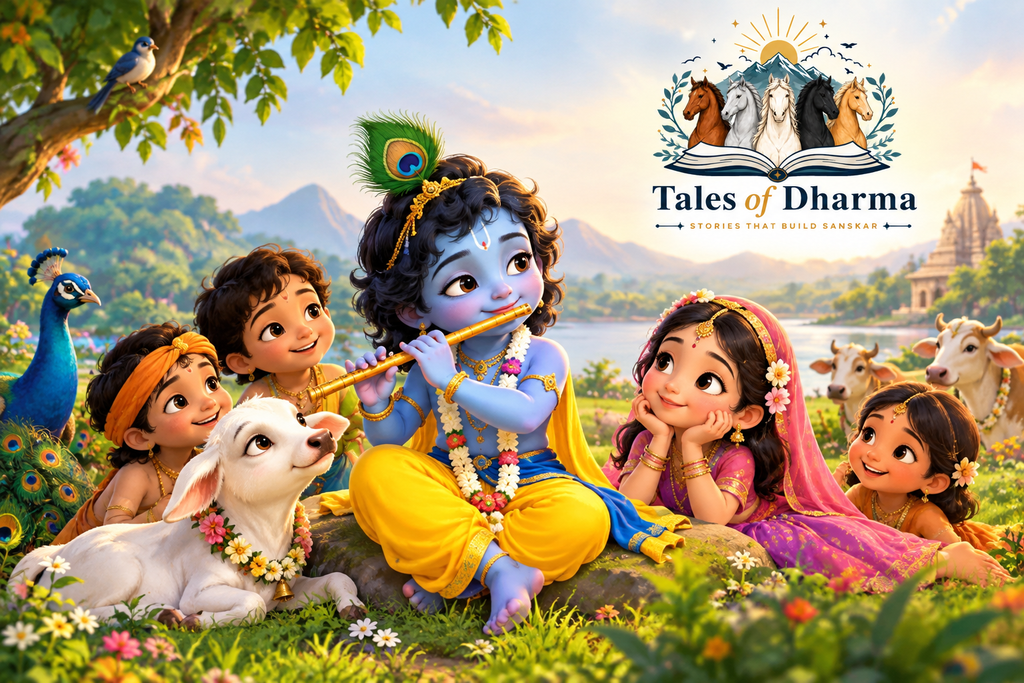
Have you ever seen a picture of Lord Krishna?
Maybe you noticed His peacock feather first.
Or perhaps His beautiful yellow clothes.
But there is one thing that almost always catches our attention:
The flute in Krishna’s hands.
A tiny wooden flute.
And somehow, in almost every picture of Krishna, He is standing peacefully, playing it.
But have you ever wondered:
Why does Krishna play the flute?
Was it just a musical instrument?
Why did everyone in Vrindavan love hearing its sound?
And why has Krishna’s flute become such an important symbol of Krishna?
The answer is more beautiful than you might expect.
Krishna and His Bansuri
The flute associated with Krishna is commonly called bansuri.
According to Krishna’s childhood stories, Krishna loved playing the flute while living in Vrindavan and the surrounding Braj region.
Imagine the scene.
The sun is beginning to set.
The cows are slowly returning home.
The trees of Vrindavan are moving gently in the breeze.
And then…
Krishna begins to play His flute.
The sweet sound travels through the forest.
The birds become quiet.
The cows stop and listen.
The people of Braj hear the music.
And everyone feels drawn toward that beautiful sound.
This is one reason Krishna’s flute became so much more than an ordinary musical instrument.
It became a symbol of joy, love, devotion, and the Divine calling the heart.
Why Did Krishna Play the Flute?
There isn’t just one explanation.
Krishna’s flute has been understood in many ways across different devotional traditions.
For children, however, there is one beautiful idea that is easy to understand:
Krishna’s flute represents a heart that is completely open to God.
Think about a flute.
A flute is simply a hollow piece of bamboo with carefully placed holes.
By itself, it doesn’t make beautiful music.
But when Krishna plays it, something magical happens.
The empty flute becomes an instrument of beautiful music.
Devotional traditions often use this as a spiritual metaphor.
The flute has no ego of its own.
It doesn’t say:
“I will play my own song.”
It simply allows Krishna’s breath and music to flow through it.
This can teach us something important.
Sometimes, when we stop saying:
“I, me, and mine…”
and become humble and open, we can become instruments for something beautiful.
The Flute’s Secret: It Is Empty
Here’s a wonderful thought to share with children.
Ask them:
“Why can a flute make music?”
They might say:
“Because Krishna plays it!”
That’s true.
But there’s another answer.
Because it is hollow.
The flute has space inside.
That space allows the music to travel through it.
This gives us a beautiful lesson:
We need space in our hearts too.
When our minds are full of anger, jealousy, pride, and selfishness, there is very little room for peace.
But when we make space for:
Kindness.
Gratitude.
Love.
Humility.
Devotion.
Life can begin to sound a little more beautiful.
So the next time your child sees Krishna’s flute, you can tell them:
“The flute reminds us that a humble and open heart can become an instrument for something beautiful.”
Why Did the Cows Listen to Krishna’s Flute?
Krishna’s childhood stories are filled with cows.
He is often called Govinda and Gopala, names associated with His relationship with cows and the people who cared for them.
When Krishna played His flute, stories describe the cows becoming captivated by the music.
They would stop grazing and listen.
Why?
In devotional storytelling, the flute’s sound is so beautiful that it attracts every living being.
For a child, you can make this simple:
“Krishna’s flute was so sweet that even the animals wanted to stop and listen.”
It also reminds us of Krishna’s gentle relationship with nature and the animals of Braj.
What Does Krishna’s Flute Have to Do With Radha?
This is where the story becomes even more special.
Radha and Krishna are deeply connected in many Krishna devotional traditions.
Krishna’s flute is frequently present in stories, poetry, music, and art about Radha and Krishna.
The sound of Krishna’s flute is often described as calling the hearts of those devoted to Him.
For devotees, this isn’t simply about music.
It represents the call of the Divine.
Imagine hearing a sound that makes you forget everything else for a moment.
That’s how Krishna’s flute is often described in devotional literature.
It reminds the heart:
“Remember Krishna.”
Did Krishna Really Play a Flute?
Krishna’s flute is a central part of His traditional iconography and devotional storytelling.
In Hindu art, Krishna is frequently depicted standing in a graceful posture with a flute at His lips.
Different traditions describe Krishna’s flute in different ways, including names such as venu, murali, and vamshi.
These names can refer to different types or descriptions of Krishna’s flute in devotional literature.
The exact descriptions vary between traditions, but the flute remains one of Krishna’s most recognizable symbols.
Why Is the Flute So Important in Krishna Stories?
Because it represents something deeper than music.
The flute can symbolize:
Joy — Krishna’s music fills the atmosphere with happiness.
Love — His flute is closely connected with the devotional stories of Radha and the Gopis.
Devotion — The music draws hearts toward Krishna.
Humility — The hollow flute is often used as an example of surrender and egolessness.
Divine connection — Its sound represents the call of the Divine.
So when a child sees Krishna playing the flute, they can understand that it isn’t simply a beautiful picture.
There is a story and a lesson behind it.
A Beautiful Lesson Hidden Inside Krishna’s Flute
Here’s a simple activity for parents.
Take a straw or a small paper tube.
Show your child that something hollow can allow air to move through it.
Then ask:
“What would happen if the flute was completely blocked?”
There would be no music.
Now connect it to the lesson:
“Just like the flute needs space for the music to flow, our hearts need space for kindness and love to grow.”
Then ask:
“What fills your heart with happiness?”
Maybe they’ll say:
Playing with friends.
Grandma’s stories.
Drawing.
Helping Mom.
Playing with their pet.
Praying.
This can become a beautiful conversation about gratitude.
What Can Children Learn From Krishna’s Flute?
1. Stay Humble
The flute doesn’t take credit for the music.
It allows the musician to create it.
Children can learn that being talented doesn’t mean we need to boast.
2. Make Space for Good Things
Just as the flute is hollow, our minds need space for peaceful thoughts.
3. Listen
The flute teaches us to pause and listen.
Children today hear so many sounds—from television to phones to games.
Sometimes silence is valuable too.
4. Spread Happiness
Krishna’s music is associated with joy.
Children can ask:
“How can I make someone happy today?”
A smile.
A kind word.
Sharing a toy.
Helping someone.
5. Stay Connected With Nature
Krishna’s childhood stories take place among forests, rivers, cows, birds, and the people of Braj.
The flute can remind children to slow down and notice the natural world around them.
Why Does Krishna Hold the Flute Sideways?
You may have noticed that Krishna is usually shown holding the flute horizontally near His lips.
This is the traditional artistic and devotional depiction of Krishna playing the bansuri.
It creates the familiar image of Krishna standing gracefully with His flute, often accompanied by cows, peacocks, trees, or Radha.
This image has become one of the most recognizable representations of Krishna.
Why Does Krishna’s Flute Attract Everyone?
In devotional stories, Krishna’s flute is described as having a sound unlike any ordinary music.
It can attract:
People.
Animals.
Birds.
And even the hearts of those who hear it.
But there is a deeper spiritual meaning.
The flute can represent the Divine calling the soul.
Just as music can make us stop what we’re doing and listen, devotion can make a person pause and remember something greater than themselves.
For children, you don’t need complicated philosophy.
Just say:
“Krishna’s flute reminds us to listen when our heart is calling us toward goodness.”
Try This With Your Child Tonight
Before bedtime, ask your child:
“If Krishna played His flute just for you, what would you want the music to remind you about?”
Maybe they will say:
“To be kind.”
“stop fighting.”
“Help my parents.”
“Share.”
“Pray.”
There isn’t necessarily a right answer.
The goal is simply to make the story personal.
Because that’s how children connect with mythology.
Not by memorizing every detail.
But by finding themselves inside the story.
Frequently Asked Questions:
Why does Krishna play the flute?
Krishna’s flute is an important part of His stories and devotional traditions. It is associated with His joyful presence, His connection with the people and nature of Braj, and the spiritual call toward devotion.
What is Krishna’s flute called?
Krishna’s flute is commonly called a bansuri. Devotional literature also uses names such as venu, murali, and vamshi in different contexts and traditions.
What does Krishna’s flute symbolize?
The flute is often interpreted as a symbol of devotion, humility, divine love, and the soul responding to the call of the Divine.
Why does Krishna’s flute attract everyone?
In devotional stories, Krishna’s flute produces music so beautiful that people, animals, and birds are captivated by it. Spiritually, its sound can represent the Divine attracting the heart toward Krishna.
Why is Krishna always shown with a flute?
The flute is one of Krishna’s most recognizable attributes. Traditional Hindu art frequently depicts Krishna playing the bansuri, especially in scenes connected with His childhood in Braj.
What does the flute teach children?
The flute can teach children about humility, kindness, listening, gratitude, and keeping their hearts open to goodness.
Why is Krishna’s flute connected with Radha?
Radha and Krishna are central figures in many Krishna devotional traditions. Krishna’s flute frequently appears in devotional stories and poetry connected with Radha and the Gopis.
Did Krishna play the flute in Vrindavan?
Krishna’s flute playing is a recurring element of traditional stories about His life in Vrindavan and Braj.
What is the spiritual meaning of Krishna’s flute?
In many devotional interpretations, the flute represents surrender and the idea of becoming an instrument of the Divine by letting go of ego and opening oneself to devotion.
The Little Flute With a Big Lesson
The next time your child sees a picture of Krishna with His flute, don’t just say:
“That’s Krishna.”
Tell them:
“Look at His flute.”
Then tell them about the music of Vrindavan.
Tell them about the cows stopping to listen.
Tell them about Radha and the Gopis hearing Krishna’s flute.
And then tell them the little secret hidden inside that simple piece of bamboo:
The flute makes beautiful music because it makes space for the music to flow through it.
Maybe our hearts can do the same.
When we make space for kindness, humility, gratitude, and love, we make space for something beautiful too.
And perhaps that is one of the sweetest lessons Krishna’s flute has been sharing for generations.
Radhe Radhe 🌸
Stories That Build Sanskar.
If you’re looking for more meaningful ways to introduce your child to Hindu stories, Indian culture, mantras, and timeless values, explore Tales of Dharma, where you’ll find thoughtfully created books and activity books for children. You can explore the collection on our website or find our books on Amazon.