
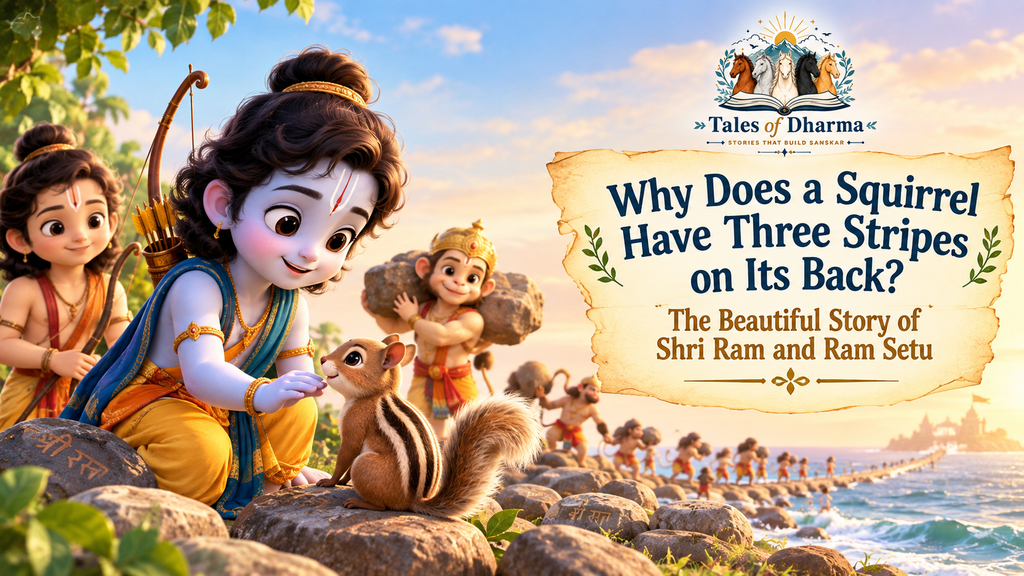
What if I told you that the three stripes on a squirrel’s back are connected to one of the most heartwarming stories of Shri Ram? Imagine a massive army building a bridge across the ocean. Huge rocks are being carried. Thousands of vanaras are working together. Everyone is trying to accomplish something extraordinary.
And then, among all these powerful warriors, a tiny squirrel decides to help.
But what happens next? Why does Shri Ram notice a creature so small that nobody else thinks its contribution matters?
Let’s discover the beautiful story.
The Bridge That Needed Everyone’s Help
Long ago, during the time of the Ramayana, Shri Ram and his Vanara Sena prepared to cross the ocean to reach Lanka.
Maa Sita had been taken to Lanka by Ravana, and Shri Ram was determined to rescue her.
The vanaras began building a bridge, known as Ram Setu, across the ocean.
Some carried enormous rocks. Others moved heavy stones and worked together to create a path across the sea.
The scene was filled with energy.
The mighty vanaras lifted rocks that seemed impossible for ordinary creatures to carry. Every moment brought the army closer to its goal.
But somewhere nearby, a tiny squirrel was watching.
She looked at the huge rocks.
She looked at the vanaras.
Then she looked at her own little paws.
And she thought:
“I may be small… but I want to help Shri Ram.”
The Smallest Helper Joins the Mission
The squirrel ran toward the sand near the shore.
She rolled her little body in the sand, allowing grains to stick to her fur. Then she ran toward the bridge and shook the sand off.
She repeated the same thing.
Again.
And again.
While the vanaras carried massive rocks, the squirrel carried tiny grains of sand.
She had no great strength. She could not lift boulders. She could not perform the work of the mighty warriors.
But she had something equally precious: the desire to serve with love.
However, not everyone understood her efforts.
“What Can Such a Tiny Squirrel Do?”
Some vanaras noticed the squirrel moving around the construction site.
They saw her carrying sand and wondered how such a small creature could possibly make a difference.
Imagine working on a massive bridge and seeing someone bringing only a handful of sand.
Would you laugh?
Would you tell them to move aside?
The squirrel, however, did not give up.
She continued doing what she could.
She wasn’t trying to compete with the vanaras.
She wasn’t trying to prove that she was stronger than anyone else.
She simply wanted to contribute.
And then, something changed.
Shri Ram noticed her.
The Moment Shri Ram Saw What Others Missed
Shri Ram saw the little squirrel working with dedication.
He understood that the value of an offering is not measured only by its size.
A vanara might carry a massive stone, while the squirrel might carry a few grains of sand. Their physical contributions were different, but the squirrel’s sincere effort was meaningful.
According to a popular Hindu tradition, Shri Ram lovingly picked up the squirrel and blessed her.
He gently stroked his fingers across her back.
And this is where the story becomes unforgettable.
Why Does the Squirrel Have Three Stripes?
According to the popular legend, the marks of Shri Ram’s fingers appeared as three stripes on the squirrel’s back.
Even today, many people share this story with children as a reminder of Shri Ram’s compassion and the importance of sincere effort.
The little squirrel, who seemed insignificant to others, had received the loving attention of Shri Ram.
Her size did not determine her worth.
Her devotion mattered.
And her story continued to be passed from one generation to another.
The Hidden Lesson Every Child Should Learn
The story of Shri Ram and the squirrel is not just about how the stripes appeared.
It asks us a deeper question:
Do we value people only for what they can achieve, or do we also recognize the sincerity behind their efforts?
A child may not be able to do something as big as an adult.
A small act of kindness may not seem important.
A little help at home, sharing with a friend, or trying again after making a mistake may appear ordinary.
But these small actions can carry great meaning.
The squirrel teaches us that we don’t need to be the strongest, the biggest, or the most powerful to contribute.
We simply need to do our part with a sincere heart.
3 Lessons from the Squirrel’s Story
1. Every effort matters
You don’t have to do something extraordinary to make a difference.
2. Never underestimate the small
Someone who appears weak or insignificant may still have a meaningful role to play.
3. True devotion is shown through action
The squirrel didn’t simply wish to help Shri Ram. She tried to help in whatever way she could.
A Story Worth Sharing With Your Child
Today, children encounter countless stories through cartoons, games, and digital entertainment.
But stories like these offer an opportunity to introduce them to the Ramayana, Indian traditions, and values through memorable characters and simple lessons.
The story of the squirrel is especially touching because it shows children that their efforts matter, even when they feel small.
At Tales of Dharma, we bring Hindu mythology and Indian cultural stories closer to children through engaging storytelling, activities, and values-based learning.
Because the stories children hear today can help shape the values they carry tomorrow.
Stories That Build Sanskar.
What Do You Think?
If you were that little squirrel, would you have tried to help Shri Ram?
And have you ever heard the story of how Shri Ram gave the squirrel its three stripes?
Share your thoughts in the comments.
Radhe Radhe
FAQs:
1. Why does a squirrel have three stripes on its back according to the story of Shri Ram?
According to a popular Hindu tradition, a small squirrel helped Shri Ram and the vanara army while they were building the Ram Setu to Lanka. Shri Ram appreciated the squirrel’s devotion and gently stroked its back, leaving three stripes as a blessing. The story teaches children that even the smallest act of help can be meaningful.
2. What is the story of the squirrel and Shri Ram?
The squirrel wanted to help Shri Ram build the Ram Setu. Although it was too small to carry large stones, it carried tiny grains of sand and pebbles and placed them near the bridge. Shri Ram noticed the squirrel’s sincere effort and blessed it. This beautiful story teaches children about devotion, kindness, teamwork, and the value of every contribution.
3. What can children learn from the squirrel story in Ramayana?
Children can learn that size does not determine the value of our efforts. The squirrel could not lift heavy stones like the vanaras, but it still helped in its own way. The story encourages children to participate, help others, and understand that even a small contribution can make a difference.
4. What is Ram Setu and why is it important in the Ramayana?
Ram Setu, also called Rama Setu, is the bridge described in the Ramayana as being built by Shri Ram’s vanara army to reach Lanka. In the story, the bridge represents teamwork, determination, devotion, and collective effort as Shri Ram and his companions prepared to rescue Sita.
5. How can parents teach the squirrel and Shri Ram story to young children?
Parents can tell the story in a simple, age-appropriate way and ask children questions such as, “How did the little squirrel help?” or “Can a small act of kindness be important?” You can also use a Ramayana storybook, coloring activity, or storytelling session to make the lesson more engaging and memorable for children.
If you’re looking for more meaningful ways to introduce your child to Hindu stories, Indian culture, mantras, and timeless values, explore Tales of Dharma, where you’ll find thoughtfully created books and activity books for children. You can explore the collection on our http://www.talesofdharma.com or find our books on Amazon.